
By Anmol Irfan Across social media platforms, women and gender minorities are increasingly utilizing tools of anonymity and self-censorship to protect their safety whilst participating in divisive public discourse. If you're a Pakistani woman active in online community groups on Facebook, chances are you’ve recently started seeing a whole lot of posts by anonymous members. …

 By Anmol Irfan
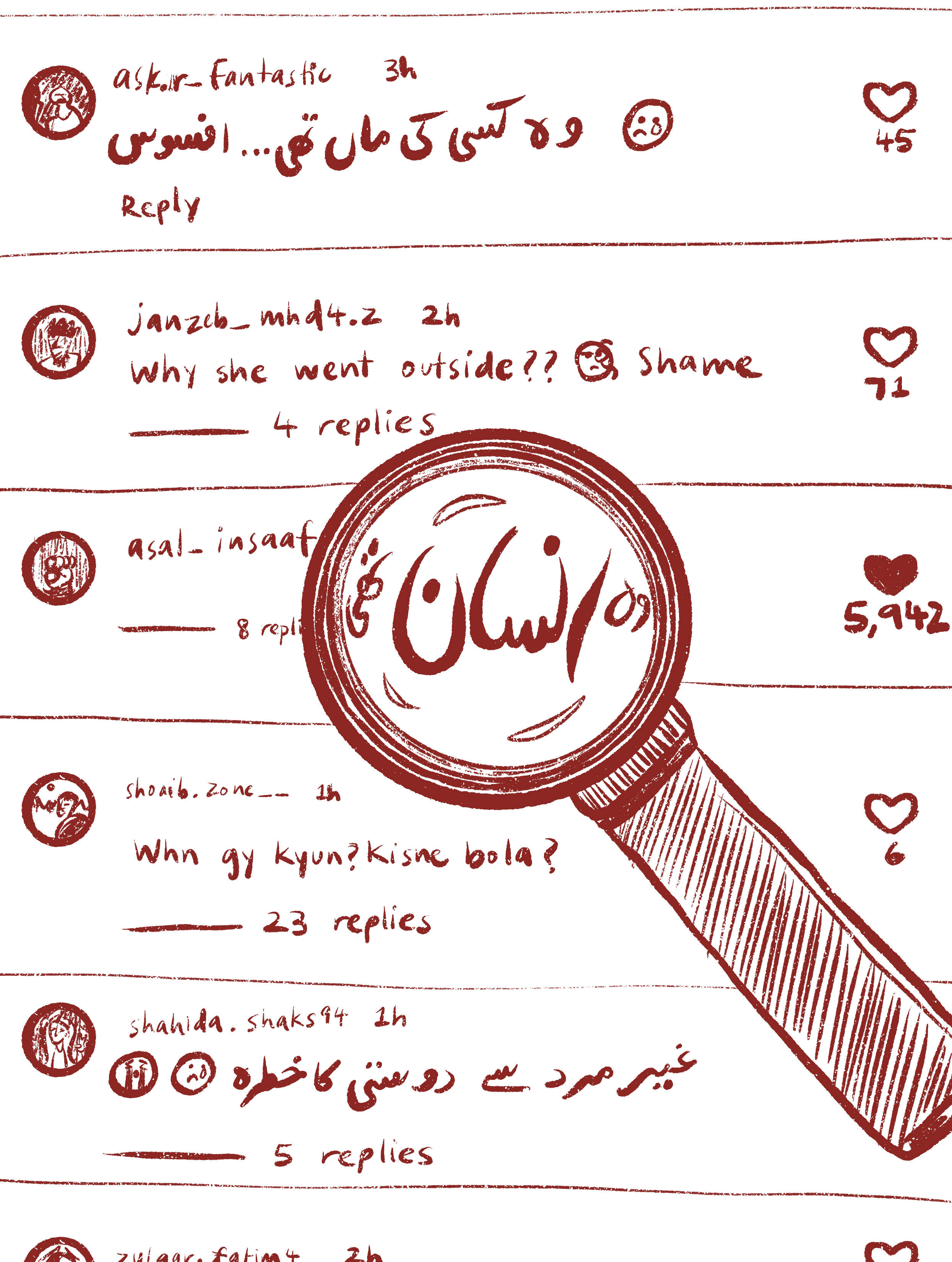
Across social media platforms, women and gender minorities are increasingly utilizing tools of anonymity and self-censorship to protect their safety whilst participating in divisive public discourse. If you’re a Pakistani woman active in online community groups on Facebook, chances are you’ve recently started seeing a whole lot of posts by anonymous members. Move this conversation to Instagram, X (formerly Twitter) or TikTok – particularly when it comes to public profiles – and you’ll hear comments like “don’t post about that topic, it’s not safe” or “I don’t share my face online.”
Even on public platforms, many women choose to keep anonymous accounts, where they might share their art, thoughts or creations but keep their names and identities a secret. A growing number of women have shared that they no longer feel comfortable posting their faces online, sharing parts of their identity, or even just sharing opinions, because of the impact it can have on them online and offline. After all, with our digital reality so interwoven with our offline lives, it’s hard to separate the two.
This rise in anonymity is linked to a rise in more misogynistic content and gendered hate that has quickly become common amidst Pakistani digital spaces – following on from global trends amidst the rise of manosphere culture. The manosphere is an umbrella term for a loose network of online communities, websites, and influencers that promote male-supremacist and anti-feminist ideologies. These groups are united by the general belief that society is biased against men due to the influence of feminism and that men are victims of social change but present in different societies in different ways. This growing online narrative pushes men towards violent, controlling behaviours by making them believe that they are trapped in a “feminist conspiracy”, and demands that they reclaim their supposed manhood by showing women what they believe is their apparent rightful place.
In Pakistan, a growing number of women have expressed fear for their physical and mental health in light of these rising beliefs online that have caused them to either self-censor their online identities, or choose to be as anonymous as possible when it comes to sharing public information. “I think it [self-censorship] emerges in subtle forms and is often internalised, like choosing my words carefully or being mindful in public forums. I often avoid or touch delicately on topics that can trigger misogynistic backlash [from men and women online], even though at times I feel that those topics are very important to discuss. Even then, I still choose safe words or tone, or for me to stay mentally sane and avoid the emotional cost of online abuse,” says Wardah Iftikhar, a gender rights advocate and development practitioner with over 8 years of experience in women’s economic empowerment, inclusive policy development, and rights-based governance across South Asia
This isn’t a recent phenomenon. Anonymity online has been a way for people to speak their mind without repercussions or consequences – on both ends of the spectrum. In Pakistan, this has increased amongst women over the last 5 years, with 2020 and 2021 seeing anonymous accounts leading the charge when it came to Pakistan’s own #MeToo movement. But it’s not all about gaining control.
Infact Annam Lodhi, a gender researcher and strategic communications specialist, wrote about this as early as 2019. Over the last 7 years, Lodhi has seen this culture evolve – although not for the better – and it prompted her to explore this further for her research. “In almost 7 years the dynamic has changed. In my masters, I wanted to explore this further. Anonymity is much more common, boys and girls are smarter now, but things have gone down the drain for women,” she shares. With a growing number of public creators and bloggers either choosing to hide parts of their identity or self-censor in the way that they speak – anonymity amongst Pakistani women may be letting them speak more, but at what cost?
The Manosphere & Pakistani Misogyny
The manosphere isn’t just about men’s behaviour, it has a deep online and offline impact on shaping women’s behavior as well. In fact, it isn’t even just men who are propagating these hateful beliefs or attacking women online. Much of this hate often comes from other women as well, who’ve internalised these misogynistic beliefs and will go out of their way to police other women if they feel that the way they’ve portrayed themselves online is “incorrect.”
“The Manosphere doesn’t just impact the way men behave and perceive the world, it directly influences women. We become fearful of being labeled as the evil instigators who are gold diggers, man-haters and whores when taking a leap of faith to display our interests in bodily-autonomy, independence and artistic liberation,” says Anha Chaudhry, an artist and content creator who chooses to keep her name and face anonymous on her public art profile.
This manosphere, or content related to it, isn’t unique to Pakistan. In fact, its rise has largely been credited to the likes of influencers like Andrew Tate and Jordan Peterson, but it seems that Pakistani society and its already rampant patriarchy became the perfect space for these beliefs to thrive and grow.
Within a Pakistani context, we’ve seen this play out in the reaction many feminist campaigns have received online. Conversations around period justice have been called shameful and wrong because many people believe these topics shouldn’t be talked about in public. Organisations like Mahwari Justice have been attacked for their name being “vulgar”. Religion is often used as a way to silence women’s public personas, which makes it even more difficult for women to speak out against these controls due to the sensitive nature of the topic. Those who do continue to speak out have to constantly worry about personal information getting leaked or putting themselves in harm’s way.
While women may react in different ways, the consequences cannot be ignored. Sajeer Shaikh, a content creator and journalist observes, “It’s interesting, because on one hand, one would expect a greater degree of self-censorship and policing to avoid it coming from external sources. Some women are definitely more selective about what they post online. But you also have pushback by certain creators who combat the manosphere, ridicule it, raise awareness about its talking points and even rage bait creators in the manosphere.”
Lodhi sees this manifest in Pakistan slightly differently to how it has in other parts of the world. “It’s a very cultural, very patriarchal issue. In my first story I called them incels. I don’t do that anymore, because incels are men in a society where people can be with each other and women don’t want to be with them. In our society, men have so much social leverage they don’t really care what women think,” she says of why the phenomena is slightly different in the way it impacts Pakistani society. For Pakistani society, the manosphere impacts cross-gender relationships differently than it does in other cultures, because these relationships are already so guarded and controlled in our culture. Women are in many cases often already seen as weaker, and their opinions seen as less important, and so they themselves begin to internalise these beliefs and restrictions and slowly take up less space online.
A defining feature of manosphere culture is what can only be described as taking up all the air in the [digital] room. There is a deliberate silencing and twisting of women’s voices through trolling, attacks, derogatory personal comments, threats, and offline blackmail. Much of this control and hate stems from beliefs made popular by the manosphere, specifically a conspiratorial attitude towards perceived changes in gender roles. The conclusion reached is that men need to re-establish their “manhood” by asserting dominance over women. This increases into a hatred for women who many men feel are stepping out of their place or who are blamed by men for apparently being the reason that they cannot be masculine in the way that they want.
For those who are part of this problematic culture, regardless of whether they are men or women, it’s clear that in their eyes women should neither be seen nor heard.
“Women and children are already vulnerable. Topics that deal with the female demographic, like health or femininity already have a limited audience so women already occupy a restricted space. Men take over that space and limit it even further” says Sarosh Ibrahim, a journalist, content creator and host of podcast Dear Body, whose own content around women’s bodies and taking up space is often in direct conflict with the men trying to silence these very conversations.
Ibrahim, whose content has often brought her under attack from such men shares some common behaviors she has noticed: “When you talk about topics concerning women, they immediately bring up topics concerning men, and will ask why are you only talking about women not men,” she says, addressing those men and adding “There’s power imbalances all around you in the domestic space, in the work space, and yet you choose to say “why don’t you talk about men”, You continue to turn a blind eye to women’s issues.” But the men she’s addressing don’t get swayed by questions like this, because the beliefs they are following are so entrenched in the spaces they occupy online. Algorithms online support this radical and harmful content, creating echo chambers for men and young boys, so this becomes the only content they often see and are influenced by. They begin to see women as enemies rather than allies, and that makes solutions even harder to implement.
When Women Are Silenced – Even as They Speak
Even as Ibrahim says that her response to such comments is often to laugh them off because of how long she’s been within this space, she admits that she too chooses to censor what parts of herself she’s showing online.
“I’ve seen that when women choose to portray themselves, there’s always a reason why they can portray themselves the way they are. I feel like where you’re situated matters a lot, and it shapes the way you portray yourself. For example, me being a single Pakistani woman who is living with her parents,I do censor myself in various ways, so the way I touch on certain topics like religion. It matters how I talk about it because of the consequences,” she shares.
Safinah Danish Elahi, an author and founder of Reverie Publishers, also has a similar approach to her public profile. What started as a page dedicated to her writing grew into a more personal space where she felt comfortable posting videos about her life. However, when a recent video with her husband went viral, it served as a chilling reminder of how vulnerable one can be to online hate. “You realise whatever you put out there can be perceived in whatever way.”
She says that awareness about how people can respond online keeps her from taking too much of a stance on politics or other issues that can be made controversial. Now that her daughter has also been building a public profile as a padel player, Elahi says that she has instructed her to only post about padel and refrain from remarking on controversial social or political issues.
“Yes, even that [padel] can trigger people so that is a concern I would have if I see someone commenting on her body or clothes or someone invading her space and saying she shouldn’t be doing that, because in the online world it is 10x or 100x easier to be made a target,” she says.
Ibrahim and Elahi still choose to share their identities online, albeit partially. For Chaudhry and countless other women, self-censorship is practiced to a more extreme degree. By prioritizing their safety over their expression, women in Pakistan often choose to exclude their public persona from online spaces.
“Honestly, I’ve had minimal reaction. That’s not because I have a welcoming audience that is open to discomfort and conversation, but because I have been too afraid to speak. It is easy to find my personal account, and I have proudly tagged both accounts on both pages to extend my visibility, but the moment I gain traction for being a distraction to the manosphere, my face will be abused with false information to defame me. I am genuinely too afraid of getting hurt to actually be myself. Upon viewing my art page, you can clearly see how curated the space is,” she shares.
She chooses to do this despite the fact that she knows it limits her work. “My work not having my face does make it limiting. My incentive to make art is my personal grievances and trauma, but I must remove traces of nuance to make it digestible for the chronic Instagram scroller,” she adds.
For other women who choose to stay anonymous, particularly in advice forums such as certain women’s groups on Facebook or to talk about topics considered “private” or “vulgar”, the choice to do so can feel empowering. After all, they can finally discuss topics that may otherwise invite judgment or attacks – not just from men but oftentimes from women as well, who become part of that same culture and pull women down. They’re not completely wrong. Anonymity, in some cases, does allow them to open the door to deeper conversations, sharing more experiences and speaking more openly about things that are taboo in our society.
Shifa Lodhi, a Humanistic Integrative Psychotherapist, also adds that the decision to stay anonymous has both pros and cons, “Yes, we can say whatever, there isn’t any track record, but it’s also harming us because it’s taking away the autonomy we used to have once,” she says.
As we become more and more comfortable in our anonymity, it raises the question of whether Pakistani women can ever safely take up space again. “Even the connection women build by bonding and supporting one another behind their online alter egos is only a coping mechanism for us. We shouldn’t have to hide and have tight circles to support one another. We deserve to be loud and public about our love and interests in each other’s work,” says Chaudhry.
After all this, silencing online isn’t just limited to the digital realm. It’s slowly shaping women and girls’ perceptions of their voices and where they are acceptable. “Online spaces are public spaces and they are a demonstration of how we deal with life offline. So when we target women in online spaces, we are shaping narratives, shaping influence and behaviour. We are trying to determine who gets to lead, who gets to speak, who gets to stay visible and have a voice,” says Iftikhar, adding that “when you’re targeting women, you’re challenging their agency, you’re policing them and that means you’re restricting their participation in political, social and civic processes. Because if they cannot exist safely online, they cannot engage in public discourse.”