
Why digital inclusion fails girls and what it takes to build it right By Marvi Soomro, Founder & Programmes Director IEI Pakistan Pakistan has called its digital transition a "digital leap." While Islamabad, Lahore, and Karachi lead the country's digital adoption, more than half of Pakistan's districts have low digital development rankings. The 2025 GSMA …

Why digital inclusion fails girls and what it takes to build it right
By Marvi Soomro, Founder & Programmes Director IEI Pakistan
Pakistan has called its digital transition a “digital leap.” While Islamabad, Lahore, and Karachi lead the country’s digital adoption, more than half of Pakistan’s districts have low digital development rankings. The 2025 GSMA Mobile Gender Gap Report finds that only around 26 per cent of rural women in Pakistan use mobile internet, compared to 49 per cent of rural men.
The standard response to this gap is technical: expand connectivity, distribute devices, teach skills. A decade of work has shown us that on its own, it doesn’t reach the girls who need it most. The technical response rests on an assumption that doesn’t hold for many girls: that access is neutral, that the digital world is equally easy to enter once the door is open, and that those who are excluded simply need an invitation.
But for many girls in remote and marginalised regions, a device does not guarantee the freedom to use it, and a digital skills course does not guarantee that her life can absorb what she has learned. Where her mobility is restricted, her access to household finances questioned, her visibility is policed, and her family’s reputation is collectively held, digital participation is never an individual act. It is a social negotiation shaped by power, one that produces four, overlapping conditions of what we call ‘unsafety’: physical, digital, social, and psychological.
This is the work most digital inclusion efforts haven’t done yet: building the conditions in which access can actually become participation.
A feminist methodology starts from a different place. It names power as the problem, not the symptoms the sector keeps treating. It treats care, safety, and belonging not only as programme features but as political acts. And it positions girls as change agents who, given the right conditions, will reshape the systems they enter.
This article draws from four years of building Tech Sahelis, a girls-only digital skills programme in Gilgit-Baltistan, to share what we call the Feminist Digital Ecosystem Methodology, an approach that shifts conditions, not just access.
The Care Ecosystem
If digital participation is a social negotiation, then inclusion has to be social work too. A girl does not exist in silos; the people and systems around her mediate her access. A feminist methodology responds to this by building care ecosystems that treat relational conditions as central to participation, not peripheral to it.
These ecosystems build trust with families, so participation is supported rather than resisted. They engage local institutions so the vision can be shared. They create peer networks so learning is collective rather than isolating. They establish community legitimacy around girls’ presence in digital spaces. They build digital safety practices around privacy, consent, and online risk.
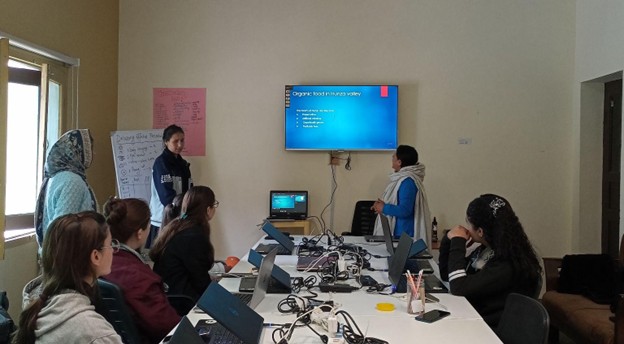
Safe spaces are central to this. The girls-only environment at Tech Sahelis didn’t come from our team deciding what was best. It came from girls and parents naming what felt safe: a physical space that is theirs, where peers become a community, a girl returns to not just for learning but for support, celebration, and belonging. A girl-centered safe space recognises that a girl carrying stress, fear, or exhaustion can not meaningfully participate, that nurturing wellness is part of the learning process.
The care ecosystem makes the methodology a feminist practice by locating the problem in structures, and not girls. It places the responsibility for change in the social fabric rather than on individual effort. And it treats care as political, as infrastructure that redistributes the burden of participation away from the girl and onto the community around her.
Learning Ecosystem
There is a fifth condition of unsafety that the care ecosystem alone cannot address: intellectual unsafety. Most training models are built around an imagined learner: confident and able to commit uninterrupted time. Many girls do not fit this mold and are expected to adapt or quietly exit. Learning environments that assume prior knowledge, penalise mistakes, and set pace according to the most confident learner make genuine engagement impossible for first-time learners, regardless of how safe the space around them feels.
A feminist learning ecosystem inverts this logic. It is in pacing a class to the slowest learner rather than the fastest. It is creating environments where mistakes are humanised. It is in noticing who is silent, confused, or withdrawing, and adjusting accordingly. It is in embedding agency in small interactions: asking before touching a keyboard, because consent matters even there. A conventional training asks: Can she keep up? A feminist one asks: Have we designed a space where she can learn?
For over 500 girls who have come to Tech Sahelis, it is the first time they have spent real time with a laptop. The pathway is built for that reality. Girls begin with foundational digital literacy, move into specialisation, and then into a period of portfolio incubation, where they have continued access to the lab, the tools, and a mentor who knows her name, knows where she started, and helps her figure out the next step. The pathway is not linear. Some girls move faster, some pause, some change direction. What stays constant is the accompaniment.
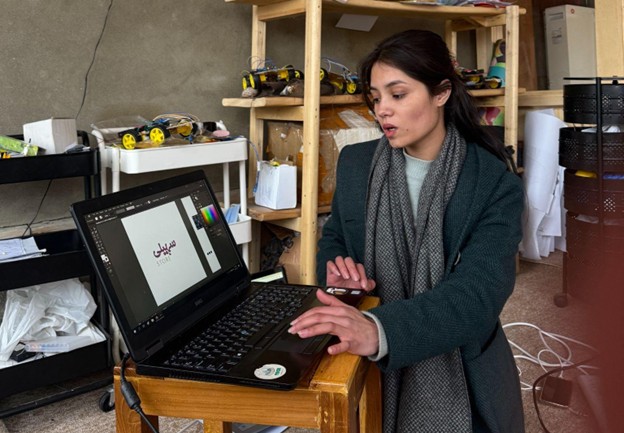
Zubia came to us as a shy girl whose mother hoped she would become more social and learn digital skills. She had left school and was studying privately. Within a year, she was leading content on Saheli Station, our girl-led Instagram advocacy platform, running campaigns on climate, girls’ education, and menstrual health, earning a stipend, and teaching herself illustration and branding. She is now designing the identity of a girl-led micro-enterprise and preparing for her undergraduate admission.
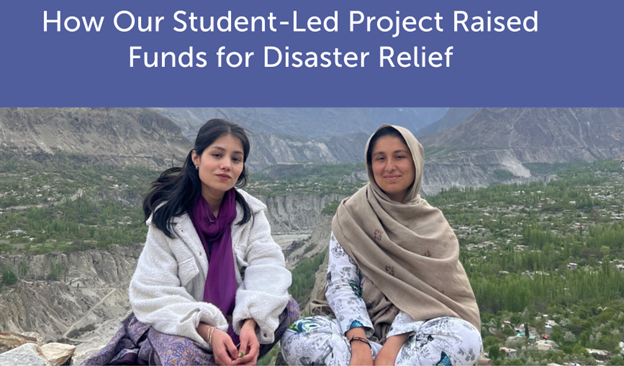
Last summer, when floods devastated valleys across GB, Zubia and her colleague, Laraib, turned Saheli Station into a relief-mobilisation platform. They gathered voice notes, photographs, and testimonies from affected communities, published them, and raised approximately 180,000 Pakistani rupees, distributed directly to families as food, medicine, menstrual products, and warm clothing. A learning space became an emergency response infrastructure.
That didn’t come from just a curriculum. It came from a learning environment that treated Zubia as someone with something to say and gave her the tools, the time, and the permission to figure out how to say it.
Creative Tech Agency
The learning ecosystem produces girls who can earn, organise, lead, and respond. What pathways are actually available to them is a separate and equally political question.
In Pakistan, that question has a stock answer: freelancing. The narrative is seductive: borderless, flexible, income in dollars, work from home. In GB, I have watched it arrive in valley after valley, carried by training programmes, government schemes, and well-meaning NGOs. And I have watched girls complete course after course with little to show for it.
Two assumptions break down here. The first is that surface-level training is enough to move a girl from skill to income on her own. The second is that the infrastructure exists to sustain it. In a region where the internet stops when the power does, where climate disasters and political disruptions cut connectivity for weeks, freelancing is a precarious foundation.
The issue is not freelancing itself. It is its elevation as the primary – and often only – model of digital economic participation. A feminist approach treats digital skills as tools for economic agency, and that shift opens multiple pathways shaped by local realities.
Sonia joined us while teaching at a local Montessori school, looking to earn better and save for further study. After building her skills with us, she moved into a placement as a social media manager at an environment-focused social enterprise. A year and a half later, she has built their digital presence from scratch and recently moved into a new role at a non-profit. Her pathway was the local economy, which is itself digitising and needs girls who can lead that transition.
Then there is what girls have built for themselves. Four girls who learned photography with us launched Bimal Studio, a photography business serving local events. Five are launching a girl-led store selling prints, greeting cards, crochet products, and recycled bags through local shops and Instagram, combining digital skills with craft traditions they already hold. These girls are business owners, not gig workers. In a region where infrastructure can’t sustain global platforms, that is often a more durable model.
Zahida joined us in her final year of university with little to no digital skills. She built her way through the full pathway and prepared to freelance. When university ended, she returned to her remote village to care for her mother. Freelancing from there was too unstable but her skills were visible. Her community appointed her as branch manager and lead trainer for a newly launched digital skills center. The skills traveled when the infrastructure couldn’t. Zahida became the infrastructure for others.
A feminist digital ecosystem does not prepare girls for a single destination. It builds the conditions for them to shape their own.
A scalable methodology for change
Inclusion limited to participation and income remains incomplete. To include girls in digital systems without shifting their position within those systems is to leave existing hierarchies intact.
The IEI Feminist Digital Ecosystem methodology extends beyond access toward agency, recognising girls and young women as actors capable of shaping the systems they enter. It is built around the Tech Saheli Leader: a woman rooted in her community, trained in feminist practice, and equipped to build the care and learning ecosystems her valley needs.
What makes her approach distinctly feminist is not a set of skills but a way of seeing. She doesn’t ask why a girl is not motivated – she asks what conditions are missing. When Asima, one of our fellows, noticed girls dropping out of her micro-lab, she called them. They had stopped coming because they felt they couldn’t do it. She asked them to come back. They returned, finished the course, and are now moving into the next one.
That is a feminist leader at work: reading the system, not the girl. She treats care as infrastructure. She designs learning around the girl in front of her, not an imagined learner. And she builds capacity that outlasts her own presence.
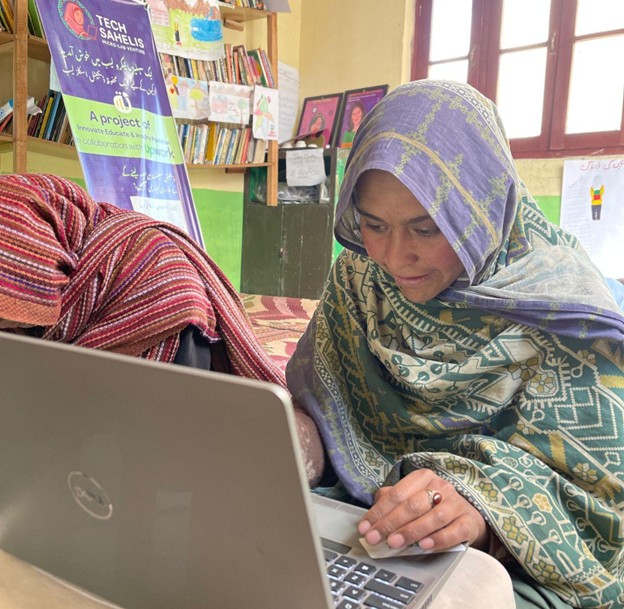
Four months into our first cohort of feminist tech leaders, three micro-labs are running across GB. For ninety per cent of them, this is the first time they’ve used a laptop. In all of these communities, no space like this had ever existed for girls. And yet, in a short time, seventy girls are completing their first digital skills course, they have found a community to learn with, and the newfound confidence and hope that their dreams are possible. Some have started offering small digital services to their local community, while others are moving further on the digital skill pathway.
From Access to Conditions
Digital inclusion has long been framed as an invitation: come, participate. But invitations assume the space is already safe, accessible, and navigable. For many girls, it is not.
A feminist methodology starts somewhere else. It does not ask how to invite participation. It asks how to build the conditions under which participation becomes possible and meaningful. Care ecosystems that address structural barriers. Learning spaces designed around girls’ actual realities. Pathways into digital economies that fit the place. Feminist leaders who are embedded within their own communities. It is a different way of thinking about digital inclusion altogether.
This is what Tech Sahelis has spent four years building, and what has emerged is not a programme producing trained girls. It is girls remaking what a digital life can look like in a mountain valley. Instagram platforms turned into sites of advocacy for girls’ rights. Localised digital content was produced where none existed before. Admission letters arriving from tech and creative fields. Businesses launched in their own communities. Mothers are becoming collaborators, expanding home businesses, and launching new ones.
Pakistan has long measured digital inclusion by what’s easy to count: girls trained, centres opened, courses completed. What those numbers don’t measure is whether a girl can actually use what she has learned, on her own terms, in the life she is living. That work is harder, but it is also the only work that will let inclusion mean something.
The question for the rest of the field is whether it is willing to build for the conditions, and not just access.
This methodology emerged through IEI Pakistan’s Tech Sahelis program, supported by Malala Fund and Upwork Foundation. Across Gilgit-Baltistan, the programme has worked with over 500 girls to build pathways toward digital agency, leadership, and community-rooted economic participation.
Supporting Links:
IEI Instagram: https://www.instagram.com/team.ieipakistan
Tech Sahelis video story: Tech Sahelis | IEI Pakistan.mp4