

By Fatima Hassan For many women, the internet is described as a space that is expansive, liberating, borderless and full of opportunity. But for many South Asian women, it does not feel like a space at all. It feels like a continuation. A continuation of being watched, assessed and of being told, in ways both …

 By Fatima Hassan
For many women, the internet is described as a space that is expansive, liberating, borderless and full of opportunity. But for many South Asian women, it does not feel like a space at all. It feels like a continuation. A continuation of being watched, assessed and of being told, in ways both subtle and violent, to stay within bounds.
So when conversations about online harassment reduce the solution to ‘log off’, ‘ignore it’, ‘grow thicker skin’, something essential is missed. These responses assume that digital harm is surface-level and that it begins and ends with the screen. But for many South Asian women, online abuse does not simply feel unpleasant. It feels existential. Because it does not land on neutral ground, it lands on bodies already shaped by silence, by surveillance, by inherited fear.
Inherited Scripts of Silence
Long before a South Asian woman creates her first social media account, she has already been trained in a language of restraint. Don’t speak too loudly. Don’t draw attention. Don’t invite trouble. Don’t bring shame. A whole list of Don’ts.
These instructions are rarely framed as oppression. They are framed as protection and survival. Passed down through generations, they form what can be understood as scripts of silence; deeply internalized rules about how a woman should occupy space, express herself, and respond to threat.
By the time she enters digital spaces, these scripts are embodied reflexes. This means that when harassment occurs online, it does not feel like a new or isolated incident. It feels familiar and almost expected.
Zainab, a journalist based in Karachi,, described this as “a strange kind of déjà vu.” The abusive messages she received after publishing a political piece, comments about her character, her ‘place’, echoed things she had heard in offline spaces for years. From relatives and from strangers.
“It wasn’t just that they were attacking me,” she said. “It was that I had been prepared my whole life to believe that this is what happens when you speak.”
Silence, in this context, is a learned survival strategy. And the internet amplifies that training.
When Harm Becomes Trauma
Mainstream discourse often treats online harassment as something irritating but manageable, a nuisance to be endured. But trauma theory offers a different framework.
Trauma is not defined solely by the severity of an event. It is defined by how the body experiences and processes threats. When an experience overwhelms a person’s capacity to cope, it can activate deeply ingrained survival responses: fight, flight, freeze, or fawn.
For many South Asian women, online abuse does exactly this. A Karachi-based psychologist working with survivors of digital harassment explained that the body does not distinguish as neatly as we assume between physical and digital threats. “If a message carries violation, humiliation, or danger,” she said, “the nervous system can respond as if the threat is immediate and real.”
This might look like:
- A racing heartbeat upon opening notifications
- Avoidance of previously safe platforms
- Hypervigilance about being watched or judged
- Emotional shutdown or dissociation
- Compulsive self-monitoring
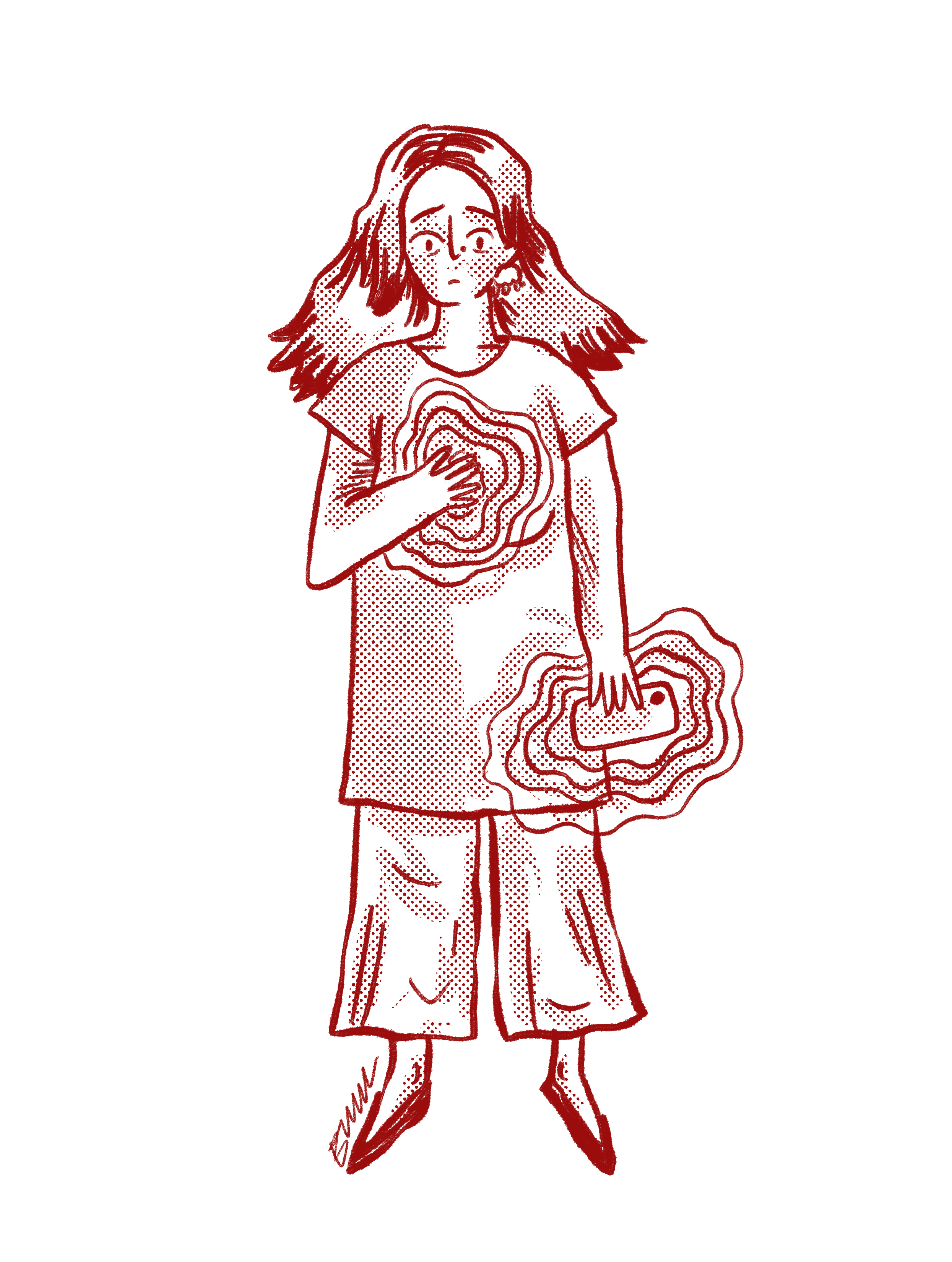
One university student, Anosha, described how a single post led to weeks of panic. “Every time my phone buzzed, I felt sick,” she said. “I couldn’t eat properly. I couldn’t sleep. I kept thinking, who else has seen this? Who is talking about me right now?”
This is not mere discomfort. It is the body entering a state of alarm. And crucially, this response is often intensified by pre-existing conditioning. When a person has been socialized to equate visibility with risk and exposure with shame, online harassment ends up confirming a lifelong fear instead of just introducing harm.
Data from Pakistan reflects a similar pattern. According to the Digital Rights Foundation’s Cyber Harassment Helpline report, women consistently make up the majority of complainants, with cases ranging from blackmail and non-consensual image sharing to sustained online stalking. The reports also highlight that many survivors experience psychological distress and are often advised by family members to withdraw from digital spaces altogether, reinforcing cycles of silence rather than addressing harm at its source.
To situate these experiences more broadly, Emma A. Jane argues in Misogyny Online: A Short (and Brutish) History that digital abuse directed at women is not random or incidental, but part of a patterned, gendered practice designed to discipline and silence. She notes that such harassment is often “vitriolic, sexualized, and relentless,” underscoring that what women encounter online is not simply disagreement, but a targeted form of hostility that seeks to push them out of public space.
The “Always Watched” Woman
For many South Asian women, surveillance is not new. It exists in the form of family scrutiny, community gossip, moral policing and general shame. It exists in the awareness that one’s actions are never entirely private and that they reflect not only on the individual, but on the family and the community.
Digital spaces collapse boundaries between these audiences. A single post can be seen by friends, relatives, colleagues, strangers, and crucially, by those who hold power over a woman’s offline life. This creates what many women describe as an “always watched” existence.
“I’m not just thinking about trolls,” said Ammarah, a 28-year-old content creator and business woman from Islamabad. “I’m thinking about how anybody might misinterpret what I do.”
This layered surveillance intensifies the impact of online harassment. Abuse is no longer just about the content of a message, it is about its potential consequences. Will this reach my family? Will this limit my freedom offline? Will this endanger me? Will this affect my reputation? In this way, digital harm becomes entangled with real-world stakes. The fear is of being exposed and attacked.
The Internalized Censor
Perhaps the most insidious effect of this environment is not the harassment itself, but what it produces internally.
Over time, many women develop what can be described as an internalized censor, a constant, vigilant voice that filters thoughts before they are expressed.
Don’t post this. This might be misunderstood. Or it might attract the wrong kind of attention. It might even cause trouble. This censor operates even in the absence of active harassment. It anticipates harm and acts preemptively to avoid it.
A freelance writer described spending hours drafting and deleting tweets. “I don’t even know if what I’m saying is controversial,” she said. “But I’ve seen what happens to other women. So I stop myself before anything can happen.”
This form of self-regulation is often invisible in discussions about digital participation. Metrics like user engagement or platform access do not capture the posts that were never made, the drafts that were left and later deleted, the opinions that were never voiced and the presence that was quietly withdrawn. Yet this is where the impact of online harassment becomes most profound. It teaches women to silence themselves first before the external forces play a role.
Withdrawal as Survival
Research by UN Women on online violence in Asia and the Pacific highlights a critical pattern: women who experience online harassment are more likely to reduce their digital participation or withdraw entirely.
This withdrawal is often framed as a loss of voice, of representation and of diversity in digital spaces. But it’s important to highlight that this is also a form of survival. Because when a space consistently produces harm, leaving that space can be an act of self-preservation. The problem is not that women withdraw. The problem is that the conditions make withdrawal necessary.
A journalist who faced sustained online abuse after reporting on gender-based violence described deactivating her account for months. “People told me I was letting them win,” she said. “But I couldn’t function. I needed to feel safe again.”
Her decision reflects a reality that is often overlooked – resilience is not infinite. And expecting women to continuously endure harm in order to maintain visibility places the burden on those already affected.
Rethinking Digital Rights: A Trauma-Informed Approach
If online harassment is understood not just as a behavioral issue, but as a form of harm that interacts with trauma, then responses must shift accordingly.
A trauma-informed approach to digital rights would begin with a simple but transformative premise: that users are not entering digital spaces as blank slates. They carry vulnerabilities and embodied experiences that shape how harm is felt. This has several implications.
First, it challenges the idea that the solution lies solely in individual coping strategies. Telling women to block, mute, or ignore abuse assumes that the responsibility for managing harm rests with the target. A trauma-informed framework would instead prioritize systemic accountability: platform policies, enforcement mechanisms, increased awareness and cultural change.
Second, it calls for recognizing the cumulative nature of harm. A single abusive message might be dismissed as minor, but repeated exposure can have significant psychological effects.
Third, it emphasizes the need for supportive responses. When women report harassment, the way their experiences are received matters. Dismissal, minimization, or victim-blaming can compound harm, reinforcing the very scripts of silence that enabled it.
Organizations working in digital rights spaces are beginning to engage with these ideas, but there is still a gap between policy and lived experience.
Beyond the Screen
Ultimately, addressing online harassment for South Asian women requires looking beyond the screen.
It requires acknowledging the cultural, social, and psychological contexts that shape how harm is experienced. It requires understanding that digital spaces are not separate from offline realities. Instead, they are extensions of them.
When a woman is told to “just log off,” what she is often hearing is – remove yourself. Make yourself smaller.
But the issue is not that women are present in these spaces. It is that their presence is met with hostility.
Toward a Different Future
Imagining safer digital spaces for South Asian women is not simply about reducing harassment. It is about transforming the conditions that make that harassment so deeply felt.
It is about creating environments where visibility does not equate to vulnerability. Where expression does not trigger fear. Where participation does not require constant self-surveillance.
This is not an easy task. It requires shifts at multiple levels – digital, technological, institutional, cultural, and familial. But it also begins with something more immediate: recognition. Recognition that online harassment is not trivial. Recognition that its impact is not uniform across genders. Recognition that for many women, it is something their bodies remember, and it reshapes how they move through the world, whether its online or offline. Until digital rights frameworks account for this reality, they will continue to fall short. Because safety is about what access costs, not just about what access is.