
Regional Engagements & Domestic Initiatives DRF at HumanX DRF Executive Director Nighat Dad joined tech experts at the HumanX event in San Francisco this April. Speaking at a panel titled Power, Policy, and the AI Race alongside Jim Baker, Senior Fellow at the Council on Foreign Relations; Nand Mulchandani, Visiting Fellow at Stanford’s Hoover Institution; …
Regional Engagements & Domestic Initiatives
DRF at HumanX
 DRF Executive Director Nighat Dad joined tech experts at the HumanX event in San Francisco this April. Speaking at a panel titled Power, Policy, and the AI Race alongside Jim Baker, Senior Fellow at the Council on Foreign Relations; Nand Mulchandani, Visiting Fellow at Stanford’s Hoover Institution; and Axios’ Senior Tech Policy Reporter Ashley Gold, she spoke to the growing need for protective frameworks as AI development rapidly accelerates.
Our Latest Research & Advocacy
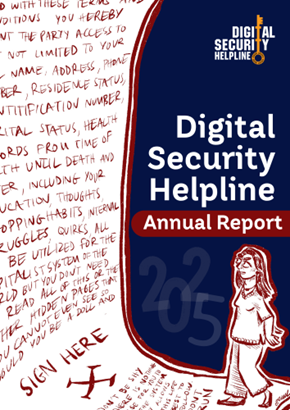 3,012 Complaints Received in 2025: Our Digital Security Helpline Report
Released in April, our Annual Helpline Report breaks down the 3,012 new complaints we received across 2025. On average, survivors reported 250 cases per month, including 2,586 instances of cyber harassment. This brings the number of cases the Helpline has received since its inception in 2016 to a total of 23,032.
The report highlights a 28% increase in cases involving minors, following a 51% increase in 2024, rising to 159 reported cases in 2025 from 124 cases in 2024. Particularly concerning are cases involving children aged 6 to 9, who, while representing a small percentage (0.23%) of total complaints, face severe risks including online grooming, sexual abuse, and digital exploitation. This rise signals a deepening child safety crisis driven by increased digital exposure and insufficient safeguards. We underscore the urgent need for parental supervision, school-based digital literacy, and child protection mechanisms to mitigate these risks.
Across cases reported in Pakistan, Punjab accounted for 69.5% of cases, reflecting both population size and better access to reporting mechanisms. Significantly lower reporting rates were observed in Balochistan (3%), Azad Kashmir (0.6%), and Gilgit-Baltistan (0.26%), indicating persistent gaps in awareness, infrastructure, and access. Notably, the Helpline also saw a 20% increase in international cases, receiving 75 complaints from 30 countries across six continents, compared to 25 countries in 2024.
Crucially, despite 79% of cyber harassment cases being referred to the National Cyber Crime Investigation Agency (NCCIA) for legal intervention, access to justice remains severely constrained. Only 51% of reported cyber harassment cases originated from cities with operational cybercrime offices, forcing many survivors to travel long distances. A total of 892 complaints were received from cities without NCCIA offices, highlighting systemic accessibility challenges. In response to institutional shortcomings, DRF expanded its legal support in 2025, assisting 143 cases through its legal team, conducting 30 court and NCCIA office visits, and directly supporting 68 survivors through in-person processes.
For more details and our recommendations, read the full report online here.
Press Coverage
‘AI is accelerating online abuse in Pakistan’
“A particularly alarming trend identified in the [Digital Security Helpline Annual] report is the continued increase in cases involving minors.” Read DAWN’s coverage of our report here.
The Rising Tide Of Online Misogyny In Pakistan
“According to Digital Rights Foundation Pakistan, 38% of women globally experience online abuse, while 85% witness it.” For The Friday Times, Fauzia Yazdani writes about the need for stronger regulations and platform responsibility to combat digital patriarchy. Read here.
Events
The Fight Against Digital Abuse
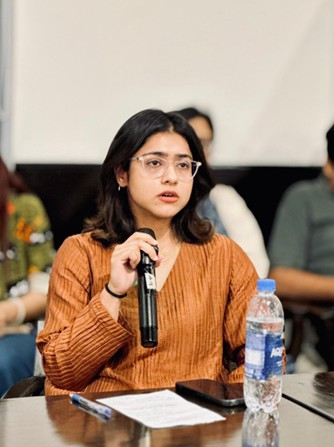 DRF was invited to speak at a panel titled ‘Digital Abuse, Deep Fakes, and Gender Based Violence in Pakistan’ by the Saeeda Waheed Gender Initiative at LUMS. Hyra Basit, DRF’s Digital Security Helpline Lead, spoke about the evolving use of AI generated and synthetic imagery to perpetuate TFGBV, the rise in cases received at the Helpline from minors and in what forms these cases manifest, as well as the need for collective stakeholder action to counter and address these issues. Hyra was joined on the panel by Moneeza Hashmi from Kashf Foundation and Ramma Shahid from Chayn.
Data Privacy, Now
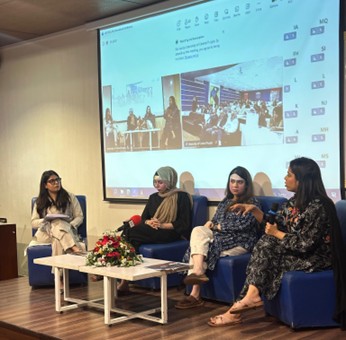 On 10 April 2026, the DRF team conducted a panel discussion titled ‘TFGBV and Data Privacy in the Age of AI’ at the 5th UCP International Conference on Law in the Age of Artificial Intelligence, held at the University of Central Punjab, Lahore. The discussion highlighted emerging legal frameworks, platform accountability, and the importance of strengthening data privacy in AI-driven digital spaces.
WISE x DRF: Digital Security for Women Empowerment
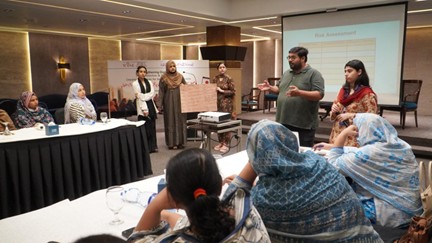 On 28 April, DRF’s IT Team conducted a Digital Security session for the WISE (Women in Struggle for Empowerment) Foundation under the theme, “Strengthening Digital Safety, Data Protection, and the Effective Use of Government Portals for Improved Community Services.”
The session brought together 20–25 women participants from regional and local communities across Punjab, who actively engaged in discussions and participated throughout the training. The initiative reflects the shared commitment of WISE and DRF to empowering women and communities through digital literacy, privacy awareness, and safer access to online platforms and government services.
Tech Trends
Musk v Altman: AI tech battle
Tech billionaires Elon Musk and Sam Altman, former partners in the creation and inception of OpenAI and ChatGPT, are set to go to trial for a federal court case. Filed by Musk, the lawsuit alleges that Altman has cheated him out of millions of dollars based on a previously shared idea of keeping OpenAI non-profit. Over the course of the month, Musk and Altman are both expected to testify in the historic case that might put the future of AI at stake.
Gemini to launch in vehicles across the US
Cars in the United States will now be fitted with Gemini, Google’s AI chatbot, alongside other in-built Google systems. Google representatives said that Gemini would now be installed in nearly 4 million General Motors vehicles, alongside other car manufacturers which have not yet been named. For now, the roll-out is scheduled to take place in the United States with English language support but availability can expand in the near future. According to the new feature, drivers will now be able to have conversations with the AI assistant and get tasks done hands-free.
Tip of the Month
As of May 8, 2026, Instagram has removed end-to-end encryption (E2EE) from direct messages. This means your chats, voice notes, photos, and videos are no longer protected by a private “lock” that only you and the recipient could access.
- Instagram can now read, scan, and store message content.
- Conversations may be reviewed by automated safety and moderation systems.
- Readable message data can be shared with authorities when legally requested.
- Private chats now have reduced privacy protections compared to encrypted messaging apps.
- Information from conversations could potentially be used for ad personalization.
How to stay safer online:
– Avoid sharing sensitive personal, financial, or confidential information through Instagram DMs.
– Move private conversations to apps with default end-to-end encryption, such as WhatsApp or Signal.
– Download and save important chat history if prompted by Instagram.
– Keep your app updated so you receive the latest privacy and security notices.
– Be aware that anything sent through Instagram DMs is not fully private.
But most important of all, think before you send.
DRF Resources
Digital Security Helpline
The Digital Security Helpline received 370 complaints in April 2026, of which 327 were related to cyber harassment.
If you’re encountering a problem online, you can reach out to our helpline at 0800-39393, email us at helpdesk@digitalrightsfoundation.pk or reach out to us on our social media accounts. We’re available for assistance from 9 AM to 5 PM, Monday to Sunday.
Legal Support
DRF’s Legal team processed six (6) complaints in April 2026, with all involving women, with the majority pertaining to blackmail involving sensitive content.
If you’re in need of any legal support or advice, you can reach out to DRF’s Ab Aur Nahin portal.
IWF Portal
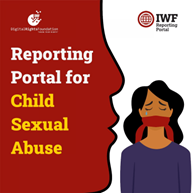
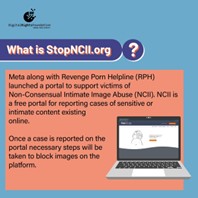
StopNCII.org