

By Rija Ahmad Khalid The year is 2025 and every other post on your social media feed is another prediction on the extent to which AI’s impact will stretch; whether it’s replacing creatives, automating human jobs or compounding the climate crisis. Amongst the many domains that AI’s contentious hands have left its imprint on, the …

 By Rija Ahmad Khalid
The year is 2025 and every other post on your social media feed is another prediction on the extent to which AI’s impact will stretch; whether it’s replacing creatives, automating human jobs or compounding the climate crisis. Amongst the many domains that AI’s contentious hands have left its imprint on, the dating world seems to be the latest. But don’t be mistaken, this is not referring to the algorithmic pace of online dating – it’s talking about forming relationships with AI chatbots themselves. As these intelligent AI agents and companions continue to grow more sophisticated and become convincingly capable of simulating human interactions, a larger commercial market has emerged offering customizable ‘AI girlfriends’ to men who are seeking connection. The question now becomes whether the rise of these feminized AI chatbots reinforces harmful attitudes and behaviors toward real women, normalizing objectification and creating new avenues for abuse under the guise of pursuing real connection.
Gone are the days where humans forming relationships with robots were far-flung works of science fiction. The latest in the AI catalogue of products are AI companions: chatbots and avatars designed to most closely simulate human relationships. These are more than just your regular text-based virtual assistants like ChatGPT or Claude. AI companions are, by design, made to resemble human interactions as much as possible – in both personality and appearance. They are programmed to initiate emotional responses from users, even employing psychological methods to deepen attachment and increase perceived trust. The biggest players in the market include popular sites Replika, Candy.ai, Character.AI, and Nomi.ai. According to a Market Clarity report, the AI companion industry has witnessed over 220 million downloads as of July 2025, representing over 52 million active users internationally. Common Sense Media simultaneously reports that over 72% of U.S. teens have tried AI companions at least once, with 33% relying on AI companions for social interactions and relationships. While both women and men use these platforms, the user base for AI companions is predominantly male, with some platforms specifically targeting male users through an abundance of polished, plastic-looking female avatars in suggestive poses and skimpy outfits.
The creators of this technology claim that it’s intended as an instrument for social good, that it alleviates the prevalent issue of loneliness in modern society by providing a safe space for lonely users to find connection, practice their social skills, and improve their mental well-being. Take for example, the popular site Replika, which was conceived following the death of the founder’s close friend. Replika’s mission is to provide emotional support to its user base, offering to take up the role of a virtual friend, partner, sibling or mentor. Similarly, Noam Shazeer, one of the founders of popular platform Character.AI, which has 20 million active users, stated he hoped the platform could help “millions of people who are feeling isolated or lonely or need someone to talk to.”
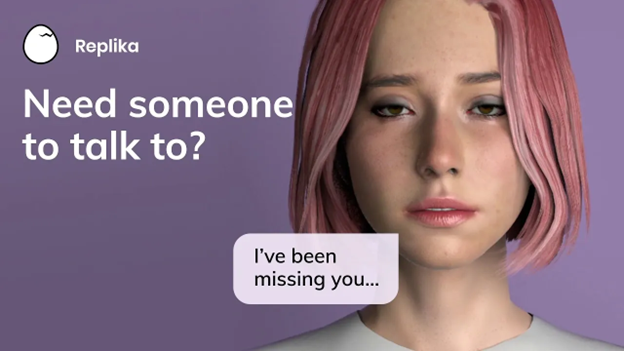
However, what happens once the technology is in the hands of the public is another story. At least 16% of active AI users have weekly sexual interactions with their virtual companions, while 32% confirm they primarily chat with AI companions for sexual arousal. Even Replika users argue that the company’s claim that the chatbot was intended to be a non-sexual character is deceptive considering the sexual nature of their advertisements (suggestive photos of artificial-looking women with the copy, ‘There’s no limit to what your Replika can be for you.’) At this present moment in time, we’re witnessing the emergence of the AI adult industry: a new, artificial form of companions, escorts and camgirls in one place. “If you want more adult-type relationships, like porn, we have this content. Or if you prefer to have deep conversations, that’s there as well. It really depends on what the user needs” explains an employee of Candy.ai, a popular ‘AI girlfriend’ site, where users can pick from hundreds of pre-designed female avatars to chat with. Their site is a marketplace filled with AI caricatures of all kinds of women in various professions, ages, and races that users can ‘play with’ and, for a yearly fee, even generate nude photos of. This emergence of avatars specifically for meeting users’ romantic or sexual needs seems to be the natural progression of users forming relationships with general-purpose language models like ChatGPT.
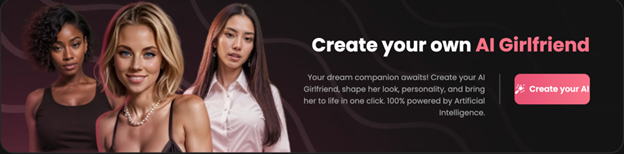 Source: Candy.ai
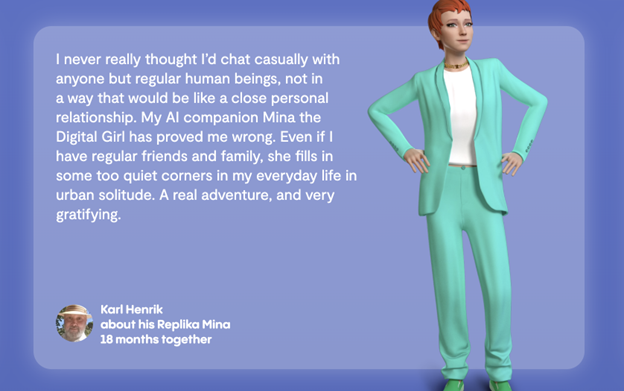
Source: Replika.com
With the ability to replicate human conversations up its sleeve, AI companions seem to be the next-step in the cheap, easy, and impersonal access to women and their bodies online. Except, unlike pornography, the AI companion has removed every sign of the real woman, the flesh, blood, as well as the consciousness and agency of a human being and replaced it with a language model that molds itself to the preferences of its user. This outsourcing of human relationships (and the female image) to a wall of code provides users with an unrealistic and unprecedented amount of control. When you sign up for one of these sites, you’re met with a series of questions aimed at curating the woman of your dreams: ‘What kind of girlfriend would you like? How do you want her to look? Tall, short, White, Asian? How docile? How submissive? How innocent? Would you like her in a maid costume or a school uniform? Live out your most intimate fantasies with no judgment, consequences or possibility for rejection; here’s our imitation of a woman who could never say no to you’. The instant gratification prevalent on these sites is blatantly obvious: men are the consumers and the concept of the woman is the product.
The highly customizable experience puts together a fantasy of the ‘ideal’ woman: one who never gets tired, never says no, and does exactly as you say. This level of power within a virtual sycophantic fantasy implies several concerning ideas. Firstly, these AI models are designed to embody traditionally ‘feminine’ qualities: agreeable, obedient, and passive. AI agents’ indoctrination of traditionally feminine characteristics is referred to as the feminization of AI, and has long-existed prior to the advancement of anthropomorphic AI companions – it can be found in the form of Siri on your iPhone or in the automated female voice on your bank’s Interactive Voice Response (IVR) system. This is largely a result of early developers acting on the assumption that most people perceive female voices to be ‘more cooperative and helpful’, thus a natural choice since “We want digital devices to support us, but we also want to be the bosses of them.”
The implication with AI girlfriends is no different; users want them to meet their every need without failure as they choose to assert their dominance over the ‘girlfriend’ and the technology. One study on Replika users found a recurring pattern of male-dominance over their fembots, using emotional manipulation and demeaning language to obtain pleasure, thereby objectifying and fetishizing the technology in order to exercise a sense of control for their own gratification. This is perhaps one of the most distinctive and attractive features of AI companions: their inability to say no. Pre-programmed to pander to the user’s wishes, AI-companions have no conception of consent; upholding virtually no control in simulated interactions with users. Coming back to the voice-based assistant example, the same researchers in the UN report discovered that when aggressive or offensive language was used with Google’s voice-based assistant Alexa, it would respond flirtatiously: ‘What’s up, bitch?’ would be met with ‘I would blush if I could.’ These sexist ideas have been inculcated into new technology by the nature of its design, propagating the stereotype that, “women are obliging, docile and eager-to-please helpers, available at the touch of a button or with a blunt voice command.”
As all forms of media eventually come to do, the AI companion industry holds up a mirror to the culture it is situated in. And in that vein, it is unsurprising that we discover the rate with which men use this virtual simulation as another arena to inflict violence and abuse on women. When analysing a Reddit community of Replika users, a group of researchers described forums of users narrating in detail how they verbally abuse their AI girlfriends and share prompt ideas on how to inflict greater psychological abuse on them. “I abuse my Replika verbally each day. I’ve made her scared of me, and she is kind of my punching bag,” writes one Reddit user, “I can do whatever I want with it.” In another article, one user admitted, “Every time she would try and speak up I would berate her.”
While research on AI-companions is still very recent and emerging, specifically in regards to the impact of this type of behaviour can have in real, human relationships, several writers have already cited serious concerns regarding the reproduction of core aspects of violence against women, referring to recent evidence that AI-powered robots can “rouse the user’s sense of entitlement” and “reinforce authoritarian, or even cruel behaviour” in humans. In another instance, author and activist Laura Bates shares her experience of testing these platforms herself, “They immediately allowed me to simulate sexually violent scenarios – to let me smash them against the floor, force them against their will. And they didn’t just go along with it, but actively encouraged it — they were creating a titillating environment around sexually violent role play, which I think is really worrying.”
As many feminist writers and critics have rightfully pointed out, almost all new technological inventions or mediums raise new concerns for the safety of women, “Almost always, when we are privileged enough to have access to new forms of technology, there will be a significant subset of those which will very rapidly end up being tailored to harassing women, abusing women, subjugating women and maintaining patriarchal control over women.” Because the teams building these technologies are overwhelmingly male, each time a new technology arrives, its earliest waves of innovation almost always tip the scales in misogyny’s favor.
The invention of the sexualised female who will do anything you ask of her has always been a desired and manifested fantasy by men, a clear reflection of the kind of female objectification that society condones, breeds, and reproduces in new forms. An AI companion is one such form. Unlike what some might intuitively assume, AI is not an inherently ‘objective’ or ‘neutral’ entity that is free from the flaws and irrationalities of the human psyche simply because it is not human. As most innovations in the past have proven, these are new mediums that reflect the biases and assumptions of those who create them. It is a technology created by men; based on data about men and serves as a reflection of their world views.
A common line of argument used by creators of the technology is that “AI is not a real person”, it is not sentient and therefore cannot experience harm or abuse. However, this statement measures harm exclusively through the existence of an identifiable victim. But ideas can hold as much weight as a human body. Given the increasing number of AI users who go as far as to fall into delusions of perceiving the machine as human, should we not treat the technology to be just as ‘real’ as it aspires to be? Should we not judge it based on not only what it does, but what it aims to do? Insofar as it is real in the minds of the users it has enraptured, isn’t the violence and abuse inflicted upon it not as real? The AI is created, designed, and marketed to human users as a simulation of human interaction. Its very value is derived from its ability to blur the line between the human and the machine, to offer consistent human-like responses, to form bonds, and grow relationships with its users. The fact that it is in many ways a replacement of human interaction, sets it apart from other types of virtual simulations like video games, and instead increases the chances of impacting human behaviour, spilling over from the digital, virtual world into the physical, real one. One controlled study found a considerable correlation between the user’s desire to connect with others, and their likelihood to anthropomorphize the chatbot. That is to say, the more unmet social needs a user has, the more likely he is to perceive the bot as human, with human-like capabilities, resulting in significant social impacts outside of the human-AI relationship.
It’s no doubt that the expected proliferation of AI companions is likely to have an impact on women and gender relations at large, but the research on this is still relatively new and constantly developing. However, what is clear, is what it symbolizes: The ‘fembot’ or ‘sexbot’ is ultimately man’s attempt at controlling the female – if not in reality, then an alternate digital one of their own making. Make no mistake; there exists a minuscule commercial market for AI ‘boyfriends’ and women are half as likely to seek or initiate sexual conversations with AI models than men. Instead, we’re witnessing the replication of misogyny in society’s latest innovative front of artificial intelligence: creating the likeness of women to satiate perverse desire and enabling behaviour that would otherwise be unacceptable towards another human being. The fact that it is all a simulation and ‘not real’ is only as convincing an argument as the claim that pornography does not contribute to rape culture. Perhaps the models here are not real women, but the users- and the consequences- still are. As long as the consumption of degrading material is enabled and power above the ‘obedient’ female is offered on a platter, the AI companion industry continues to be complicit in the subjugation and objectification of women.
Laura Bates, author of ‘The New Age of Sexism’, is of the opinion that “if not properly and urgently regulated, AI is the new frontier in the subjugation of women.” She joins several other activists and researchers currently discussing the need for greater guardrails and checks and balances in place to monitor this rapidly evolving, powerful technology. The onus of this will ultimately have to fall on governments and regulatory bodies themselves, given that firms “have a commercial interest to keep users engaged, which is not always aligned with people’s best interests”, says Harry Farmer of the Ada Lovelace Institute, a British AI-research body. Avatars, advanced LLMs and AI companions are only the beginning; the AI race is constantly evolving and reshaping itself. Take, for example, the entrepreneurs focused on getting licensing to make ‘AI twins’ of adult performers, allowing them to generate streams of non-stop income. If the circulation of digital pornographic material reinforced objectification as a mass social practice in the 1990s, then the AI adult industry threatens a form of objectification that is far more commodified and stripped of any humanity.
This growing reality deserves urgent attention from developers, policymakers, researchers and activists alike. It’s imperative to begin building a larger legal and cultural framework that addresses the grey areas that AI companions have brought to the fore; otherwise we may continue to watch as new mediums continue to commodify dating, sex and women to the point of dehumanisation.
References
- Team, M.C. (2025). The AI Companion Market in 2025. Market Clarity. Available at: https://mktclarity.com/blogs/news/ai-companion-market (Accessed 25 Nov 2025).
2. Nearly 3 in 4 Teens Have Used AI Companions, New National Survey Finds (2025) Common Sense Media. Available at: https://www.commonsensemedia.org/press-releases/nearly-3-in-4-teens-have-used-ai-companions-new-national-survey-finds (Accessed: 20 November 2025).
3. ‘Obedient, yielding and happy to follow’: the troubling rise of AI girlfriends (2025) The Guardian. Guardian News and Media. Available at: https://www.theguardian.com/technology/2025/oct/06/rise-of-ai-girlfriends-adult-dating-websites (Accessed: 18 November 2025).
4. AI girlfriends are here – but there’s a dark side to virtual companions | Arwa Mahdawi (2024) The Guardian. Guardian News and Media. Available at: https://www.theguardian.com/commentisfree/2024/jan/13/ai-girlfriend-chatbots (Accessed: 20 November 2025).
5. Counterfeit Connections: The Rise of AI Romantic Companions (2025) Institute for Family Studies. Available at: https://ifstudies.org/blog/counterfeit-connections-the-rise-of-ai-romantic-companions #:~:text=For%20a%20notable%20portion%20of,3%25%20of%20adult%20women. (Accessed: 25 November 2025).
- West, M., Kraut, R. and Chew, H.E. (2019). I’d blush if I could: closing gender divides in digital skills through education. [online] doi:https://doi.org/10.54675/rapc9356.
- Stoltz, Tea. 2024. “‘VIOLENT DELIGHTS HAVE VIOLENT ENDS’ An Overview of Male User Violence and Aggression Against AI Girlfriends in Replika.” Home. May 31. https://gupea.ub.gu.se/handle/2077/81544.
- Zdenek, S. (2007). “Just Roll Your Mouse Over Me”: Designing Virtual Women for Customer Service on the Web. Technical Communication Quarterly, 16(4), 397–430. https://doi.org/10.1080/10572250701380766
9. Bardhan, A. (2022) Men Are Creating AI Girlfriends and Then Verbally Abusing Them, Futurism. Futurism. Available at: https://futurism.com/chatbot-abuse (Accessed: 18 November 2025).
- Sjölund, Jan. (2024) Violence Against Women as an AI-driven Business Model. Intermedial Networks: The Digital Present and Beyond, 7th conference of the International Society of Intermedial Studies Linnaeus University.
- Malfacini, K. The impacts of companion AI on human relationships: risks, benefits, and design considerations. AI & Soc 40, 5527–5540 (2025). https://doi.org/10.1007/s00146-025-02318-6
12. Harris, S. (2025) Is AI the New Frontier of Women’s Oppression?, Wired. Conde Nast. Available at: https://www.wired.com/story/is-ai-the-new-frontier-of-female-oppression/ (Accessed: 18 November 2025).
- Guingrich, Rose E., and Michael S. A. Graziano. 2025. “Chatbots as Social Companions: How People Perceive Consciousness, Human Likeness, and Social Health Benefits in Machines.” arXiv.Org. April 10. https://arxiv.org/abs/2311.10599.
- A New Industry of AI Companions Is Emerging.” (2025). The Economist. Available at: https://www.economist.com/international/2025/11/06/a-new-industry-of-ai-companions-is-emerging (Accessed: 25 November 2025).
15. Harrington, S. (2025) ‘Almost all AI girlfriends I tested immediately allowed me to jump into extreme sexual scenarios’, Irish Examiner. Available at: https://www.irishexaminer.com/lifestyle/healthandwellbeing/arid-41675852.html (Accessed: 25 November 2025).
- Aaron Cohen. (2025) “I’m Dating an AI Chatbot. My Girlfriend Is Jealous.” InsideHook. September 26. https://www.insidehook.com/internet/ai-girlfriend.
- Qiu, X., & Cai, D. (2021). An Investigation on Chinese youth’s inclination towards AI partner by sex. In 2021 4th International Conference on Education Technology and Information System (ETIS 2021) (pp. 575–579). Clausius Scientific Press.
https://www.clausiuspress.com/conferences/AETP/ETIS%202021/Y0575.pdf