

As smartphones reshape rural journalism in Pakistan, women remain more visible than ever, yet too often as subjects of stories rather than their authors Author: Wardah Iftikhar Villages across Pakistan have never lacked storytellers. They have only differed in which storytellers are believed. In many rural communities, men gather in baithaks and jirgas to …

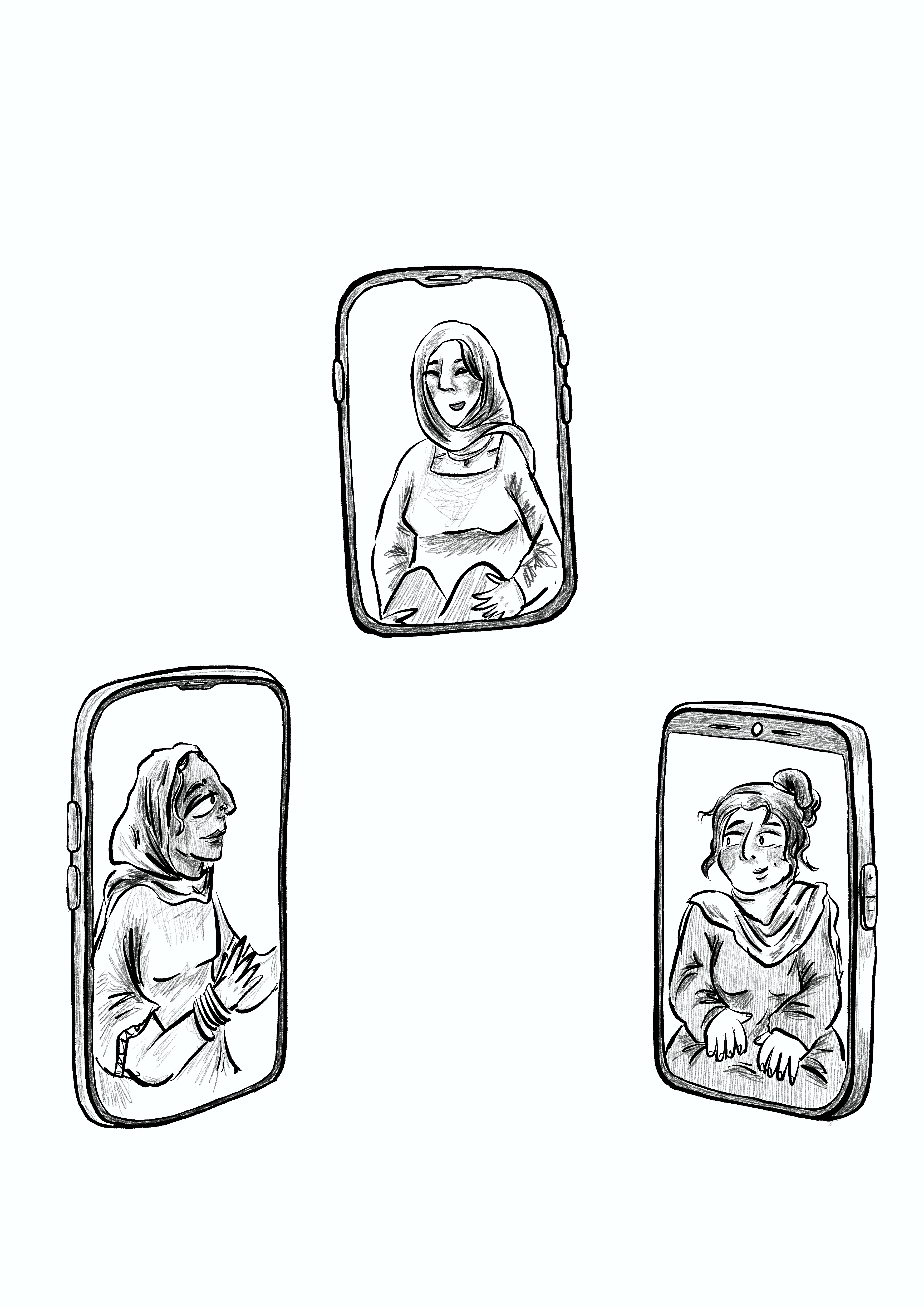
As smartphones reshape rural journalism in Pakistan, women remain more visible than ever, yet too often as subjects of stories rather than their authors
Author: Wardah Iftikhar
Villages across Pakistan have never lacked storytellers. They have only differed in which storytellers are believed.
In many rural communities, men gather in baithaks and jirgas to debate politics, discuss crop prices, settle disputes, and exchange news. Their conversations are recognised as part of public life, shaping decisions that ripple across the village. Just a few houses away, women build equally rich networks of knowledge while embroidering, harvesting crops, preparing weddings, washing clothes, or visiting neighbours. They track rising food prices before inflation becomes a headline, discuss schools where teachers have quietly stopped showing up, exchange health advice, and preserve the social memory of their communities.
Yet these conversations are rarely treated with the same legitimacy. What happens in the baithak is often understood as civic participation. What happens among women is more easily dismissed as gossip or domestic chatter. The distinction is not about the quality of information being shared. It is about whose knowledge society has been conditioned to value.
The rise of smartphones and digital media promised to disrupt these old hierarchies. Information could travel farther and faster than ever before. A woman no longer had to wait for a newspaper reporter or television crew to reach her village before documenting a broken road, a failed harvest, or an injustice. A WhatsApp voice note could carry local news across districts in minutes. A mobile phone could become a newsroom in the palm of a hand.
But technology has changed the speed at which stories travel far more than it has changed who is trusted to tell them.
The optimism around digital media rests on a seductive idea: that once everyone has access to a smartphone, everyone has an equal opportunity to participate in public discourse. In rural Pakistan, the reality is far more complicated.
For many women, digital access is conditional rather than guaranteed. According to the GSMA Mobile Gender Gap Report 2025, women in low and middle-income countries are 14 per cent less likely than men to use mobile internet, while more than two-thirds of the 810 million women who remain unconnected globally live in South Asia and Sub-Saharan Africa. The report attributes this gap to factors including affordability, digital skills, safety concerns, and social norms. In Pakistan, these constraints are often reinforced within the household, where a phone may exist but belong to a husband, father, or brother, and decisions about internet use are shaped by both finances and family expectations.
This distinction is easy to overlook but impossible to ignore. A woman may have access to a device and still feel unable to post publicly, contact a journalist, or document an issue without fearing scrutiny from her family or community. Digital inclusion is therefore about more than connectivity. It is about agency, autonomy, and the confidence to participate in public life without fear of social repercussions.
In an interview for this article, Saro Imran, a youth activist from Multan, reflected on how owning a smartphone did not automatically translate into freedom of expression. “I have internet access, but I still think twice before posting anything publicly because I know relatives, neighbours, and strangers are watching. Having a phone is not the same as having the confidence to use your voice,” she said.
At the same time, the shift to mobile-first media has transformed how rural communities consume and circulate information. Young Pakistanis increasingly encounter news through Facebook, TikTok, YouTube, and messaging applications rather than traditional newspapers or television bulletins. In villages where literacy levels remain uneven, WhatsApp voice notes have emerged as an especially powerful tool, allowing information to travel in local languages and familiar accents and making news and community updates accessible to people who might otherwise be excluded from text-based formats.
In many ways, these voice notes resemble older traditions of oral storytelling. They carry updates about crop diseases, market prices, missing livestock, local disputes, or a road blocked after heavy rain. They spread condolences, organise weddings, and warn neighbours of emergencies. They also allow people especially those with limited formal education, to participate in information networks without relying on written communication.
Jamil, a pesticide vendor in southern Punjab who has never learned to read or write, is one such example. His business now runs through WhatsApp voice notes. Instead of typing, he records updates for farmers about available pesticides, seasonal crop diseases, and when new stock has arrived. His WhatsApp status simply reads, “Voice karain” (send a voice message), and whenever someone sends him a text, he replies with a sticker asking them to send a voice note instead. His broadcast lists have become an extension of the conversations that once took place across fields and village markets, showing how technology has expanded, rather than replaced, long-standing oral traditions.
But there is another side to this transformation.
The same voice note that makes participation easier can also become a vehicle for misinformation. A forwarded message stripped of context can travel across districts within minutes, acquiring credibility simply because it came from a trusted contact. Mobile journalism can document neglected realities that mainstream media ignores, but it can also bypass the editorial checks that distinguish reporting from rumour.
Nadia, a domestic worker in Islamabad, experienced this firsthand during the 2025 floods. A video reached her through WhatsApp, accompanied by messages claiming that her village had been submerged and her home had been swept away. Convinced that her family had lost everything, she packed her belongings, left her job, and travelled home. It was only when she arrived that she realised the footage had not been recorded in her part of the village. Her home was untouched. The message had travelled faster than anyone had taken the time to verify it, and by then, Nadia had already uprooted her life.
For women, the stakes are often even higher. Digital platforms collapse audiences. A photograph shared with relatives may end up in the hands of strangers. A private video can be copied, recirculated, and judged outside the context in which it was created. The internet remembers what communities might once have forgotten.
These concerns are not hypothetical. As Pakistan’s digital landscape expands, so do the risks women face online. In 2024, an estimated eight million new female users came online, marking important progress in digital inclusion. Yet the same year saw more than 135,000 cybercrime complaints, while only 826 cases proceeded to prosecution, a rate of just 0.6 per cent. This gap between access and accountability illustrates a troubling reality. For many women, entering digital spaces also means navigating harassment, cyberstalking, image-based abuse, impersonation, and other forms of technology facilitated gender based (TFGBV) violence with limited avenues for redress.
The experiences of prominent journalists such as Gharida Farooqi, who has repeatedly faced coordinated online harassment campaigns, illustrate how visibility in digital spaces can come at a disproportionate cost for women. For aspiring reporters, particularly those in rural and underserved communities where reputational pressures are often more acute, the prospect of abuse and intimidation can become a powerful deterrent to speaking publicly in the first place.
In conservative settings, this loss of control is not merely uncomfortable. It can shape a woman’s willingness to speak at all. The possibility of surveillance, online harassment, or reputational harm means that many women weigh the cost of visibility before they ever press “send”.
The chilling effect of online abuse extends beyond individual incidents. A 2022 report by the International Center for Journalists (ICFJ) and UNESCO found that women journalists around the world are disproportionately targeted by online violence, including coordinated harassment, threats, and intimidation, with many reporting that the abuse affected their mental well-being, professional engagement, or willingness to continue participating in public discourse. In Pakistan, digital rights organisations have similarly warned that online attacks and technology facilitated gender based violence create an environment in which many women self-censor or limit their visibility online. The result is a quieter but no less damaging form of exclusion, where women are technically present in digital spaces but are discouraged from participating fully.
A digital rights advocate working with women facing online abuse in Khyber Pakhtunkhwa, who asked not to be named for security reasons, said many women eventually retreat from public platforms altogether. “The harassment is often designed to make women doubt whether speaking up is worth the cost. In that sense, online abuse becomes a form of censorship,” she said.
The paradox is striking. Technology has lowered the barriers to publishing, but it has not dismantled the social hierarchies that determine whose stories are welcomed, whose stories are questioned, and whose stories are considered too risky to tell.
A smartphone can turn anyone into a publisher. It cannot, on its own, make them an accepted narrator.
The challenge is not only social. It is also institutional. Journalism in Pakistan remains a profession marked by significant risks and shrinking diversity. The Committee to Protect Journalists (CPJ) has documented 75 journalists and media workers killed in connection with their work in Pakistan since 1992. In its 2024 Global Impunity Index, Pakistan ranked 12th among countries where journalists are murdered and perpetrators routinely escape justice.
Within this environment, women continue to occupy an increasingly marginal place in the profession itself. According to findings from the Global Media Monitoring Project reported by Dawn, women reporters accounted for just 4 per cent of journalists in Pakistan in 2025, down sharply from 16 per cent in 2020. The same study found that women made up only 13 per cent of news subjects and that every story featuring women on the monitoring day was reported by a man. These figures are not merely indicators of representation. They shape which questions are asked, which sources are considered credible, and which experiences become newsworthy. Every missing woman reporter represents relationships that are never built, communities that are never accessed, and stories that never make it to publication.
The consequences are particularly visible in rural Pakistan. In many conservative communities, women cannot freely interact with unrelated men or speak openly about family, health, or financial matters. Women journalists are often better positioned to access spaces and conversations that may remain inaccessible to their male colleagues, particularly in communities where social norms shape who can speak to whom.
Speaking for this article, Aeman Sheikh, a community reporter based in Dera Ghazi Khan, said that access is less about gender preference and more about trust. “When I enter a village, women are willing to discuss issues they would never raise in front of male reporters, from maternal healthcare to domestic finances and local governance. Those conversations often change the story entirely,” she said.
Yet even when rural women do speak, their words often pass through multiple layers of interpretation before reaching the public. A reporter selects the quote. An editor shortens it.
This dynamic is not unique to journalism. It is also evident in development practice, where institutional priorities can reshape personal narratives. In my own work in the development sector, I have seen remarkable women reduced to a paragraph labelled “beneficiary story,” which makes it to a donor report highlighting measurable outcomes. The version that survives publication is often optimistic, linear, and reassuring. The version shared over tea in the village is rarely so simple. It contains hesitation, humour, compromise, disagreement, and the countless invisible negotiations that make social change possible.
Development and journalism are not malicious for seeking stories that inspire or demonstrate impact. But they often privilege stories that are measurable over stories that are meaningful. A donor may want evidence that a programme increased girls’ enrolment in school. A journalist may need a concise quote before a deadline. Neither format easily accommodates the mother who spends years persuading relatives to keep her daughter in school, or the young woman who succeeds only after abandoning one dream to protect another.
In trying to make stories legible to institutions, we sometimes strip them of the very complexity that made them true.
That is why authorship matters. Being represented is not the same as being heard, and being quoted is not the same as controlling your own narrative. Rural women do not simply deserve a place in the story. They deserve the authority to decide how that story is told, what context it requires, and what parts should never be edited out for the sake of convenience.
One local woman from Swabi put it differently. “People come asking why my girls left school, but they already have the answer in their minds. They write about poverty or early marriage. No one asks what happens when girls have to walk long distances and face harassment on the way, or whether there are toilets and menstrual hygiene facilities in schools. And even if my girl studies, people still say, ‘Aakhir karna to roti chulha hi hai. Miss thori lag jaye gi.’ That part never makes it into the story.”
Perhaps the most overlooked resource in rural journalism is not technology but trust. Trust that women are experts on their own lives. Trust that the conversations unfolding in courtyards, fields, and community gatherings are not peripheral to public discourse but central to it. And trust that ethical storytelling sometimes requires the journalist to step back and allow the narrator to lead.
There is a temptation to view technology as a replacement for older ways of knowing. But in rural Pakistan, the smartphone has not replaced the baithak, nor has social media erased the conversations that unfold over shared labour and everyday routines. Instead, these worlds exist side by side. A WhatsApp voice note may carry the same concern that was discussed that morning while harvesting wheat or stitching clothes. The platform is new. The practice of collective storytelling is not.
The challenge is ensuring that these traditions survive without being stripped of their depth. Too often, journalism rewards what is immediate, development rewards what is measurable, and algorithms reward what is sensational.
Stories that unfold slowly, carry cultural memory, or resist neat conclusions struggle to compete. Indigenous knowledge, oral histories, and local dialects are compressed into captions, translated into project indicators, or ignored altogether because they do not fit the logic of trends and timelines. Yet these are precisely the stories that give communities their resilience. The grandmother who remembers when a canal last carried water, the artisan who knows why younger girls are abandoning a centuries-old craft, or the farmer who can trace changing weather patterns across decades are not simply sharing anecdotes. They are preserving archives of knowledge that rarely appear in official records but shape everyday survival.
Journalism has an opportunity to do more than document these voices. It can recognise them as experts. Development practitioners can do more than collect testimonials. They can allow beneficiaries to become narrators rather than illustrations of impact. Digital platforms can do more than amplify content. They can create pathways for communities to tell their own stories without surrendering ownership over them.
The future of rural journalism will not be determined solely by faster internet, better cameras, or wider smartphone penetration. It will depend on whether we are willing to rethink who counts as a storyteller. If women’s experiences continue to be filtered through institutions, translated into donor language, or narrated by others, digital inclusion will remain incomplete.
Rural women have never lacked stories. They have preserved histories, documented change, challenged injustice, and interpreted their communities for generations. The challenge before journalism is not to find more stories about them, but to trust them to tell their own stories, preserve their own contexts, and define their own realities.
Only then can we move beyond representation to genuine authorship. Only then can we say that the journey from baithak to broadcast has not merely changed how stories travel, but who gets to own them. The future of ethical journalism lies not in speaking for rural women, but in having the humility to let them speak for themselves and the discipline to leave their stories intact.