
Ayesha Mirza The author is a journalist focusing on social justice, climate change, minority rights, and gender issues. [Disclaimer: The article does not compare the experiences of these women; rather, it highlights how misinformation, moral policing, and misogyny surrounding deceased women online have intensified over time.] In the last few years, Pakistan has witnessed a …

Ayesha Mirza
The author is a journalist focusing on social justice, climate change, minority rights, and gender issues.
[Disclaimer: The article does not compare the experiences of these women; rather, it highlights how misinformation, moral policing, and misogyny surrounding deceased women online have intensified over time.]
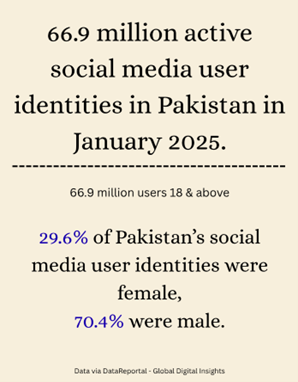
In the last few years, Pakistan has witnessed a sharp rise in internet and social media use. While a seemingly promising expansion for many, especially women, given increased access and opportunities, social media platforms have become an increasingly dangerous terrain. They are now ripe spaces for misinformation, disinformation, misogyny, and targeted harassment of women, particularly those in the public eye.
From the murder of Pakistan’s first social media influencer, Qandeel Baloch in 2016, to actress Humera Asghar Ali’s tragic death in 2025, social media users have become increasingly relentless towards women not only when they’re alive but especially after their deaths. The moral policing, public scrutiny and speculative claims made about deceased women are especially alarming with an increase in users assuming that it’s their responsibility to inform or misinform others about the circumstances of these deaths, their families’ responses, and spread imagined moral lessons that they believe to be important.
Shmyla Khan, a researcher on gender and digital rights, says, “Grief becomes gendered online. A woman’s death is never just a tragedy; it’s treated like a moral lesson.”
Given that Qandeel Baloch was the country’s first social media influencer and openly challenged traditional notions of gender and sexuality, the media and public’s reaction to her content, and their response to her eventual death, set the precedent for how people would view the cases that followed.
Qandeel Baloch (2016)
Born Fouzia Azeem, Qandeel Baloch was known for her outspoken persona and unapologetically bold online content, most commonly found on Facebook or YouTube. She was strangled by her brother in July 2016, who claimed to have done so to “protect family honour” because of her “shameful” pictures on Facebook. Though the discourse on television and in print was intense, the social media conversation was less widespread than what we see today possibly since, despite it being 2016, fewer social media platforms operated with concepts such as engagement and algorithmic reach being close to non-existent.
From our review, there were fewer comments overall. Moral policing existed in the form of criticism of her content, shaming her family, but it was limited in scale. In many ways, her death paved the way for the voyeuristic obsession and moralistic commentary that now routinely follow women’s deaths online.
Though on the one hand, most posts about her death at the time were news coverage, her song videos, or compilations of her earlier content – i.e. modest engagement compared to today’s viral posts – the comment sections were increasingly hostile. Some users branded her a “prostitute” and reprimanded her publicly, criticising not just her behaviour but her entire online persona.
Under a Facebook post by The Express Tribune about her father’s reaction to her death, many comments accused her family of exploiting her fame for financial gain, intending to shame both Baloch and her grieving family.

Sana Yousaf (2025)
In June 2025, 17-year-old social media influencer Sana Yousaf, known for her popular content on TikTok and Instagram, was shot dead by a 22-year-old man named Umar Hayat. As per police accounts, the accused, who confessed to the murder soon after his arrest, broke into Yousaf’s home in Islamabad on 2 June 2025 and shot her twice in the chest
When news of Yousaf’s death first broke on social media, users quickly attributed her death to an honour killing. Even under posts that simply announced her passing, commenters insisted that her father, brother, or cousin was responsible. This influx of unverified claims created an immediate wave of misinformation surrounding her death.
Platform dynamics also played a major role. The rise of short-form reels has allowed misinformation to spread more rapidly than it did in 2016, when content was mostly limited to static posts or longer videos. Reels have made misinformation easier to package and more shareable. For instance, Shirin Shokrollahi’s analysis of Instagram reels showed that their brevity and sensory intensity allow complex narratives to be condensed into emotionally engaging clips, which the platform then amplifies through engagement-driven algorithms. Similarly, a multimodal study of TikTok, Instagram, and YouTube health videos found that authority cues and fear-based storytelling make misleading content appear credible.
In the aftermath of Yousaf’s death, Facebook in particular was flooded with misleading and false claims in the form of reels. While reviewing viral posts surrounding her death, I repeatedly came across unrelated videos of people crying or mourning, footage of dead bodies, and clips claiming to show the perpetrator. Most of these claims were false.
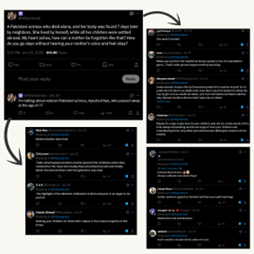
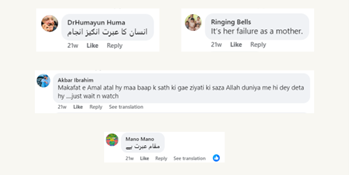
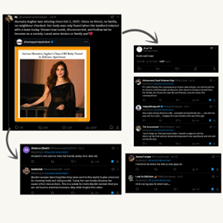
The viral posts attracted thousands of comments ranging from people celebrating her killing to blaming her parents for “poor upbringing,” to policing her social media presence, and ultimately blaming the 17-year-old for her own fate. Even today, months after her death, Sana Yousaf’s content continues to circulate on social media regularly and is often filled with negative comments.
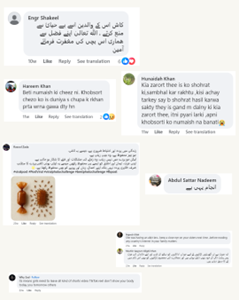
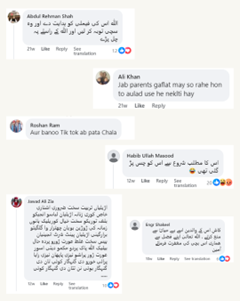
Comments left under different posts reporting Yousaf’s death
Comment sections function as more than just spaces for individuals to engage with and react to content; they are places where people converse, shape narratives, and collectively form opinions. As these cases show, they also serve as powerful accelerators of misogyny, misinformation, and public moral judgment.
Ayesha Khan
On 20 June 2025, veteran Pakistani actress Ayesha Khan was found dead in her Karachi apartment. Her body appeared to be around a week old when discovered, as reports stated that the actress had been living alone. “As per the station house officer, she passed away naturally,” Senior Superintendent of Police Dr Farrukh Raza told Arab News.
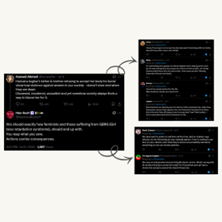
One might have expected that social media users would at least spare an older and widely respected figure, who seemingly died under normal circumstances; however, a different form of misinformation took over. Most posts announcing her death were accompanied by captions offering condolences and regret. In the comments, many users expressed sympathy and lamented the showbiz industry’s neglect. Others quickly jumped to conclusions about her personal life, alleging she had strained relationships with her children or had neglected them in their early years to pursue a career in entertainment.
Some dragged in “feminist values,” “liberalism,” “Western models of living,” and independence. Such comments imply that a woman who lives independently is ultimately responsible for whatever happens to her. Her circumstances, rather than being understood with empathy, were recast as character flaws. A few even claimed this is the “fate” of women who work in showbiz, ultimately blaming the deceased for being found dead in her apartment.
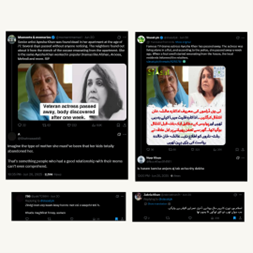
X posts regarding Ayesha Khan’s demise
Humaira Asghar Ali
In the first week of July 2025, actress Humaira Asghar Ali was found dead in her Karachi apartment when a court bailiff arrived on 8 July to vacate the property following a complaint by her landlord. The bailiff forced the door open and discovered her dead body inside.
Karachi Police Surgeon Dr Summaiya Syed initially noted that the body was in a “very advanced stage of decomposition,” suggesting she may have died around a month earlier. Further investigation into Humaira’s phone records, her social media activity, and interviews with neighbours, pointed to an earlier timeline.
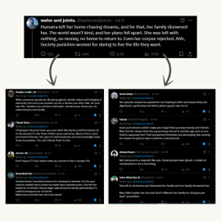
In Ali’s case, her family’s initial refusal to claim the body added yet another layer for public scrutiny. It gave many social media users more ammunition for criticism. Under posts reporting her death, people attacked her for defying “family values,” pursuing a career in showbiz, and even in death, policing her choices.
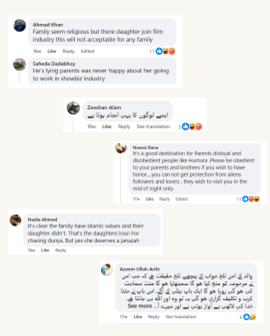
On X, three separate users posted about her passing and questioned why her family or friends had not checked on her. Below these posts, several users claimed her family was justified in disowning her. Others insisted she had chased fame, rejected traditional values, or that this was the fate she deserved for pursuing independence. Some users cursed her outright. She was also claimed to be a feminist, and that this is what happens to women “for being feminist,” implying she somehow deserved her cruel fate.
Posthumous commentary
Digital commentary and reactions are not random. They draw from long-standing cultural notions about women’s morality, independence, and honour. When commenters invoke “feminist values,” “liberalism,” or “Western lifestyles,” they are suggesting that a woman’s autonomy is inherently dangerous or socially corrosive, and therefore a plausible cause of her suffering or death. These comments reflect an attempt to impose meaning on tragedy by presenting women’s choices, visibility, or careers as moral failings. In doing so, they recycle familiar misogynistic narratives, i.e., that women invite harm by stepping outside prescribed roles, and that their behaviour, not violence, is what requires scrutiny. In this way, the online response to these cases becomes less about the facts and more about policing the boundaries of acceptable womanhood. Speculation about the private lives of these women was treated as moral evidence, allowing strangers to assign blame rather than confront the violence or tragedy itself.
Women’s Public Presence
In Pakistan, a woman’s public presence has always been a contentious issue. Feminist scholar, activist, and author Afiya S. Zia traces this back to Benazir Bhutto’s tenure as prime minister. Bhutto’s body and choices were subjected to constant commentary, but at the time, the criticism was mostly confined to newspapers, Zia explained. Today, the landscape is different because news breaks online first and then moves to TV and print. Online conversations now directly shape offline attitudes.
Female public figures, then, are almost like a litmus test, and even in death, they are not granted any grace. Unsurprisingly, most people do not see anything wrong with posthumous commentary, particularly on one’s character or choices. Shmyla Khan aptly points out that, “People think they’re providing moral commentary and not harassment.”
Another issue is that people equate women’s public visibility with “feminism,” something both Zia and Khan noted. In Pakistan, “feminism” is often used as a catch-all accusation implying that a woman is immoral or rebellious. Her public presence is then treated as a political stance rather than ordinary visibility, which in turn becomes justification for hostility, scrutiny, and moral policing in the comments. This presumption adds another layer of scrutiny, particularly when the woman is young, outspoken, or challenges social norms.
The situation becomes especially troubling when it comes to dead women. Their absence emboldens audiences, allowing people to speak with more cruelty, certainty, and entitlement than they do about living women.
Comment section as a narrative machine
People leave comments to either acknowledge content or to feel acknowledged, express an emotion or a feeling, and join in on a conversation. However, for platforms, comments posted under content serve as a performance indicator of which topics are or aren’t gaining more traction online. On Facebook, for example, a comment is not just a response, but a signal to the algorithm that the post is provoking interest, which then prompts Facebook to push it to more users. More comments lead to increased visibility, which leads to even more comments. This process, invariably, ends up creating a visibility loophole – while people may comment with the intention of challenging or refuting the harmful narratives, they only end up further boosting engagement. Pushback, therefore, can unintentionally promote what it’s trying to shut down.
Facebook does hide or downrank certain comments, such as spam, suspicious links, heavily reported replies, or words filtered by page admins, but these mechanisms have major gaps.
Community guidelines
Meta’s Community Standards prohibit hate speech, bullying, harassment, and the non-consensual sharing of intimate images. The platform outlines protections against attacks based on gender, prevents the shaming of private individuals, and provides reporting tools intended to keep users safe. However, its 2025 policy overhaul relaxed certain prohibitions. For example, Meta now allows allegations of mental illness based on gender or sexual orientation, and permits exclusionary language rooted in political or religious discourse.
Most of the misogynistic comments found under posts about deceased women do not directly violate these narrow definitions. They don’t include hate speech or sexual content. Instead, they weaponise moral judgment through insinuations, “warnings,” and victim-blaming commentary framed as cultural concern – forms of harm that policies do not recognise.
Even when Meta’s third-party fact-checkers rate content as false or misleading, the comments on such posts remain visible. People are more likely to scroll through comments than read the fact-check. This is partly driven by social proof, the tendency to trust other people’s reactions more than verified information, which allows misinformation to survive even after moderation.
People look toward others to reaffirm their biases, so comments often reinforce the misogynistic stereotypes already deeply embedded in Pakistani society. Comment threads ultimately shape collective memory. What people “remember” about a deceased woman often comes from what strangers speculated online, and not what actually happened.
Digital misogyny
Sociologists Sarah Banet-Weiser and Kaitlyn Miltner, in their study “#MasculinitySoFragile: culture, structure, and networked misogyny”, argue that gendered hate is not random trolling but structured, coordinated, and sustained through male-dominated digital spaces. Users reinforce each other’s hostility through comments, threads, memes, and group identities. This is clearly visible in comment threads under posts about deceased Pakistani female public figures, where people echo, escalate, and legitimise harmful narratives. While men dominate these threads, women also participate in posthumous moral policing. Banet-Weiser and Miltner suggest that algorithms reward outrage and anonymity protects abusers allowing such narratives to flourish.
Anonymity emboldens users who know they can protect their real identities. Even if their accounts are suspended, they can reappear with new ones. The problem is twofold. Platforms lack adequate mechanisms to intervene, and Pakistani laws do not always offer a pathway to report or address such behaviour – especially in cases involving deceased women, where no one is likely to pursue action anyway.
Afiya S. Zia and Shmyla Khan both emphasised that digital misogyny is a continuation of older patriarchal scripts, now amplified by technology. Zia believes “online misogyny is an extension of an old patriarchal system that seeks to control women’s sexuality, autonomy, and even property.” Social media has accelerated its spread, but the root remains the same, “fragile masculinity, sexual policing, and structural inequality.”
Abuse in the form of social media posts and comments is often seen as harmless or humorous making it easy to dismiss. However, Banet-Weiser and Miltner note, online hate often appears playful or normal, which is why it spreads more effectively. They assert, simply being visible as a woman is dangerous. This danger is magnified in Pakistan, where women’s online presence is often equated with feminism, liberalism, or Western values. “It doesn’t matter what women wear; simply being visible violates the boundaries patriarchy has set,” says Zia. “In Pakistan, women’s bodies are treated as national property; symbolic of modesty, religion, and identity,” she added.
While Qandeel Baloch’s case set the precedent for how public outrage and moral policing unfold online, the situation has intensified in recent years. The systems that enable misogynistic narratives have only grown more sophisticated, and the consequences more severe.
In Yousaf, Khan, and Ali’s case, many users may have shared posts simply to “inform” others of their deaths but intent becomes irrelevant on platforms driven by engagement. Once a post enters the algorithmic cycle, it attracts comments, and these threads quickly fill with misogynistic, moralising, and speculative remarks about the deceased and their families.
These comments reinforce patriarchal control over women, both in the public eye and in their private lives. Banet-Weiser and Miltner argue that misogynistic harassment can push women out of digital spaces, limiting their democratic representation. Ordinary Pakistani women face even higher risks. When families or male guardians see how female public figures are treated online, they tighten restrictions on the women in their own households, particularly when their deaths are framed as warnings about what happens to women who are too visible.
Is there a way forward?
Account owners or moderators often argue that public figures are exempt from privacy concerns, and platforms themselves are unlikely to disincentivise content centred on viral tragedies. Shmyla Khan pointed out, “Platforms have no real incentive to remove misogynistic content because it drives engagement.” Emotionally charged posts, especially those involving the death of young or famous women, attract higher engagement.
When false, misleading, or negative comments appear under news coverage, social media managers rarely intervene to correct misinformation because engagement boosts visibility. In reality, there is no effective mechanism to report or remove these comments. “Reporting systems don’t work because they weren’t built with gendered harassment in mind,” Khan explained. “The burden is always on women to report, document, explain, even when they’re the ones harmed.”
Platforms do technically allow users to report comments, but their guidelines overlook misogynistic moralising, sympathy baiting, and posthumous shaming. Journalist Sidra Dar notes that “many of these platforms operate in Western contexts where hate speech, bullying, or harassment differ significantly.” Consequently, the narratives that emerged around the four deceased women seldom register as violations and remain online.
In the absence of meaningful laws and amid gaps within platform policies, dead women in Pakistan are left without the dignity they deserve. Misinformation and disinformation about them continue to flourish, reinforcing the same patriarchal controls that seek to limit women’s presence in the public sphere, both online and offline. Banet-Weiser and Miltner say women face emotional, psychological, and political harms simply for existing online. Unfortunately for Pakistani women, these harms do not end with death.