
By Zoya Anwer Pakistan has been getting hotter for years, but it is often heat, more than floodwater, that makes climate change feel immediate to those watching from the urban centres. Heat is easier to imagine as a shared national condition because floods, by contrast, expose another divide: they do not reach all crevices, and …

By Zoya Anwer
Pakistan has been getting hotter for years, but it is often heat, more than floodwater, that makes climate change feel immediate to those watching from the urban centres. Heat is easier to imagine as a shared national condition because floods, by contrast, expose another divide: they do not reach all crevices, and despite attempts, do not receive equal attention when they devastate rural, riverine and already under-reported regions.
South Punjab happens to be one such place.
In 2025, the South of Punjab became one of the clearest examples of how climate disasters hit regions that are already pushed to the margins of national coverage. By late August, overflowing rivers had displaced thousands of families, with Layyah, Taunsa Sharif, Kot Addu, Dera Ghazi Khan, Muzaffargarh, Rajanpur and Multan reported among the worst-affected districts. In Multan, floodwaters entered villages and damaged crops and mango orchards; in Kot Addu, residents of Ehsanpur and Hinjrai evacuated with their livestock; and at Head Taunsa, flows reached 500,000 cusecs, threatening downstream areas of D.G. Khan and Rajanpur.
By early September, the crisis had deepened around Muzaffargarh and Multan. AP reported that rescuers and the military were delivering aid in districts where floods had inundated around 3,900 villages after the Ravi, Sutlej and Chenab burst their banks. Earlier reports said floodwaters had submerged dozens of villages in Muzaffargarh, while displacement across Punjab had reached 1.3 million people and 3.3 million people had been affected across 33,000 villages. UNICEF’s September update, citing the Rapid Needs Assessment in Punjab, said 4.2 million people were affected and 2.8 million displaced across 18 targeted districts. By October 1, NDMA’s final consolidated monsoon situation report recorded 322 deaths and 665 injuries in Punjab since 26 June, along with 1.94 million acres of crop damage, 213,097 houses damaged, 3,992 livestock lost, and 2.82 million people rescued through 4,749 rescue operations.
But numbers can only explain the scale of a disaster.
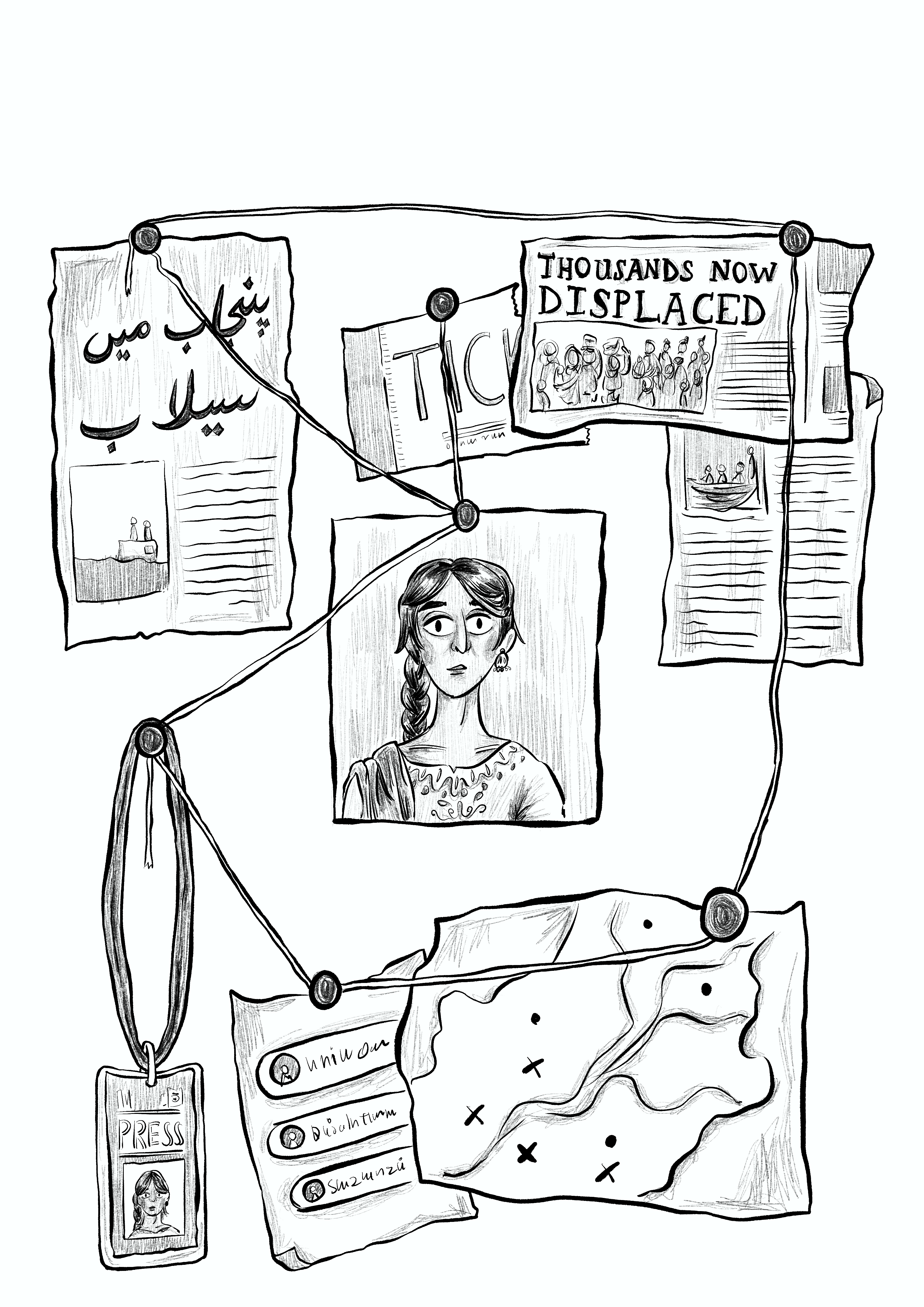
They fail to explain what it means to stand in a village you know like the back of your hand, among people who may speak your language, recognise your family, or look to you not only as a journalist but as someone who might help. For women journalists from South Punjab, this is where the story begins. Laiba Zainab, Aneela Ashraf and Mahjabeen Abid report from a region they know intimately, in languages and communities that are often buried deeper under ‘tickers’ by mainstream media.
Their work asks what it means to cover a crisis when the people affected are neighbours, relatives, women they can reach because male reporters often cannot, and communities whose losses do not end when the headlines flash and disappear. Their reporting is shaped not only by the climate crisis, but by gendered barriers, newsroom indifference, limited resources and the burden of witnessing suffering too close to home.
An entire geography of stories
For Mahjabeen, reporting from South Punjab has never been only about where she is based. It has shaped the stories she chooses, the people she listens to, and the way she understands journalism itself. She has worked in news media for around seven years, beginning with regional TV channels and digital outlets in Multan around 2019 and 2020. Those early years helped her understand the media landscape, but also showed her what it repeatedly failed to see.
“I gradually realised that my real interest lies in telling the stories of marginalised communities, and by margins, I mean margins,” she says. “Stories of vulnerable groups of people, of women from here, in the streets of cities, and in the Cholistan desert. My focus shifted towards these communities, keeping in mind the fact that these are the people whose lives and stories rarely make it into mainstream coverage.”
There are bureaus of major television channels in the region, but Mahjabeen says presence does not always mean attention. South Punjab has a rich cultural history and its own social and environmental complexities, yet it is often covered only when it enters the language of crisis.
“If you look at the reporting, mainly it happens around some crisis: that South Punjab’s agriculture has been affected, or some disaster has happened, or there is an emergency situation, or an election, or a flood. You will see more coverage then, or the bigger media outlets will report only then,” she shares.
That limited attention shaped how she began to see her work. She did not want to wait for calamity before telling stories from the region she belonged to. “I felt that where I come from, I have to tell the stories of that place. And I do not have to tell them only around a specific event. I have to do my daily reporting from here. I do not have to wait for a calamity or a disaster to tell the stories of my region, the place I belong to, where I live, where I grew up, where my work is based.”
Laiba’s understanding of location comes from another experience: being underestimated because of it. Early in her career, while trying to work in bigger cities, she was told something she still remembers.
“Even when I went to Karachi back in 2016, there was this person who told me, ‘You are just a person from a small city who thinks she has wings to fly.’”
For Laiba, the remark reflected a broader judgement about who is allowed ambition. “A lot of people assume that if you’re a journalist from a smaller region or a smaller city, you should not have that much confidence. Or you should only work on certain topics, take softer beats, and that is about it. You should not be ambitious or passionate at all.”
Over time, as she worked in bigger cities, the perception changed. But the change itself says something about how credibility is built in Pakistani journalism. “Now they feel, ‘Oh, this is a serious person, and we should sometimes take this person seriously,’” she laughs knowingly.
Aneela’s answer to what shapes reporting from South Punjab comes through the language of pitching. When she speaks about floods, she immediately also begins to think like someone who has had to make editors understand why a story matters so much. She frames the disaster through poor planning, women’s health, relief camps, encroachments, the return of river routes, and the human cost behind each number.
“A flood is not just a surge of water,” Aneela says. “It leaves behind administrative failure, human tragedy, and centuries-old geographical truths. The 2025 flood, which began from Multan and spread to other districts of South Punjab, was not merely a natural disaster. It was the result of wrong decisions and of looking away from realities on the ground.”
For her, the story is not only about water entering villages. It is also about who was already vulnerable before the water arrived. “These are not just numbers. Behind every life lost is the story of an entire family’s destruction,” she says.
The newsroom’s map is smaller than the region
For Laiba, climate reporting from South Punjab begins with the field itself becoming harder to predict. Heat, rain and floodwater no longer follow the neat seasonal rhythms reporters once relied on.
“You see how much heat you have to go into for reporting. Suddenly, it starts raining, or flooding begins. The weather has become so unpredictable because of the climate crisis,” she says. “Earlier, maybe ten years ago, you could plan things differently while reporting, according to the season, what is happening and what is not happening. Now things are very different.”
But the larger difficulty is access. Most offices, senior officials and decision-makers in Punjab are concentrated in Lahore. For reporters based in Multan or further south, this limits access to data, press conferences, officials and the chance to ask questions directly.
“If you are someone from Multan, your access to them, your access to data, your access to ask questions, your access to hit the right nerves, all of that is very limited because you do not even get the opportunity to speak to those people directly, to attend their press conferences, to ask them questions, or to question their policies.”
The distance is geographical, but it is also institutional. “If you are sitting somewhere three or four hundred kilometres away, they do not even take you seriously,” Laiba says. “They do not think, ‘Okay, these people should be given some importance.’”
Mainstream bulletins, she says, still turn around Lahore, Karachi and Islamabad. Politics is important, but the result is that regions like South Punjab are often visible only when there is a large enough crisis. Reporting from Alipur, Muzaffargarh, Layyah or Rahim Yar Khan requires time and money, and newsrooms do not always see the value in spending either.
Aneela describes this same distance through what happens when reporters challenge official accounts. When journalists try to report on relief camps, poor aid distribution or the condition of women and children, access can be restricted.
“When you are focused on your story and trying to present the facts, the administration does not give you access to those people or to the flood relief camps because you are trying to investigate and report the reality,” she says. “Journalists who did stories about how people doing relief work, or NGOs, were not being allowed to work, also faced a lot of backlash. It was said that they had done false reporting, and they were called in and threatened.”
Although this story is centred on South Punjab, Saba, a journalist from Narowal in North Punjab, says the same neglect shapes rural reporting elsewhere. Villages may be full of stories, but they remain distant from mainstream media unless an editor can easily locate them on the national map.
“I don’t think my area is really connected with mainstream media spaces,” Saba recalls. “News from here hardly reaches mainstream media, especially the kind of news that actually matters to people in rural areas. Issues of farmers, women farmers, climate and rural livelihoods rarely make it to mainstream news channels.”
For Saba, the problem is not that the stories are absent. It is that they are not treated as urgent when they come from villages. “If there is an issue that exists in both a rural and an urban area, editors prefer the urban story because they think it will get more reach,” she says. “When we pitch stories from villages, they are delayed or rejected. Nobody knows where that village is. But if the story is from a major city, everyone immediately understands where it is from and why it matters.”
Barriers before the story
For Mahjabeen, the biggest barrier remains how society still views a woman journalist. She prefers to call the region Saraiki Waseb, though she uses South Punjab professionally when needed. In many areas, she says, the idea of a woman carrying a camera, driving, travelling independently and reporting from remote places still feels unfamiliar.
“Things have improved over the years, but journalism is still largely seen as a profession that requires a level of mobility and freedom that women are not always expected to have or encouraged to cultivate,” she says. “I come from a relatively privileged and supportive family background, but even then, I still find myself having to seek permission from my parents before travelling to certain locations outside Multan. And it is not that they do not support my work, but because of genuine concerns around safety, distance, and the challenges that come with reporting from remote regions.”
This makes her think of women reporters without the same resources or family support. “If these barriers exist for someone with my background, then I think about how difficult and how impossible it must be for other women who do not come from a privileged background like mine.”
Mobility is a practical challenge before it becomes a professional one. A reporting trip to Cholistan, Thal or Koh-e-Suleman requires transport, local contacts, planning and money. Local media organisations often want ambitious field stories without paying for what those stories require.
“They want work from you, but they do not know how you are doing that work, whether you are spending money from your own pocket or how you are managing it,” Mahjabeen explains. “You expect journalists to produce ambitious and meaningful stories without providing them enough support for transportation, equipment, and accommodation. They want a story from Cholistan, but they do not know how long it took the reporter to get there, where they stayed, and what their safety situation was.”
For freelancers, she says, the costs can make the work unsustainable. “You do not just have to go and do one story. First, you have to do a recce, then you have to look at your fuel expenses. You have to manage local coordination. And it can take days of reporting. Then what they commission you for does not even cover your basic costs.”
Her conclusion is direct: “Passion alone cannot sustain a profession.”
Aneela places some of the hardest barriers inside the community itself. “First, there is the biradari system. Second, there is the long tribal area, a belt of more than 400 kilometres along the Koh-e-Suleman range,” she says. “The cultural barriers there are exhausting to cross. Sometimes you are not allowed to reach people. Then there are social barriers. There are some women who cannot even come out during the flood because they are not given permission.”
During floods, these barriers become matters of safety. In rural and tribal areas, homes are often open or without boundary walls, and displaced families can be left under the open sky. “The protection of adolescent girls, adult girls, and newborn babies becomes a very big challenge,” Aneela says. She alleges that during the last flood, girls faced sexual and other forms of violence, and newborns were vulnerable to being taken away through informal guardianship or sale. “Mothers are not getting proper food. Children do not even have milk available. And the food in flood relief camps is so bad that even our animals eat better food than that.” Amidst these aggravating challenges, reporting on vulnerable communities becomes even more important.
For Aneela, children, women, transgender people and persons with disabilities are often the most neglected in any crisis. Reporting on them is not only about visibility, but about trying to make aid reach them. “The purpose of journalism,” she says, “is that while doing stories on all of these groups, they are highlighted so that the reporting can have some effect and aid can reach them.”
What language carries
Language determines who can speak and what survives when a story travels. Mahjabeen says mainstream media has improved in some ways, with Saraiki soundbites sometimes preserved rather than replaced, but digital platforms still often subtitle, translate or voice-over local speech. Translation may be necessary, but it changes the texture of what is being said.
“Our main language is Saraiki, our local language,” she says. “So if you look at any stories, or if we are covering floods, or any environmental issue, or any story, you will find very powerful emotions. First, the story itself will be very rich, but your local language makes it even more impactful. If we talk about human-angle stories, if we talk about emotions, all of that exists in that language.”
She is not arguing against translation but erasure: “Local languages have their own references, their own expressions, and translation cannot always help with that. The local voice, the local expression, should not be compromised because language determines your visibility.”
Language is also a point of access. A woman reporter who can speak to other women in Saraiki, Punjabi or the local idiom of a village may enter spaces where male reporters often cannot. This matters for stories about health, sanitation, childbirth, violence, displacement and relief camps. Yet access does not automatically become recognition.
“If there is a particular issue affecting women, or a community, or families, then women will go there more than men and you will see them reaching those spaces,” Mahjabeen says. “But then another thing comes in: assumptions are made about credibility, assumptions are made about expertise, and about the kind of stories women are expected to cover.”
To this, Laiba also sees how women are pushed towards softer beats and questioned when they pursue harder stories. Aneela describes women reporters doing the work anyway, often in the harshest conditions.
“Women go and do all of this themselves,” Aneela says. “During floods, they also appear live on air. They stand for many days in the rain, in the sun, and in the heat. During the flash flooding of 2022 and 2025, there were also very heavy rains at the same time.”
The ‘objectivity’ obsession
The emotional cost of reporting from home is difficult to separate from the work itself. Laiba says that during last year’s floods, the water came much closer to Multan city than in previous years.
“It does hit home, of course, it hits home. It feels like anything can happen at any time,” she says.
Standing there as a reporter can produce a painful contradiction. People may believe your reporting will bring help, while you know visibility does not always lead to action.
“When you are in that region, when you are sitting there, when you are seeing people suffering and seeing how miserable things are, for so many days and so many nights, you keep having nightmares,” Laiba says. “Maybe you would not have those nightmares if you were only sitting and watching visuals. But if you go there and speak to people, then it affects you more, 100 percent.”
For Mahjabeen, some of the worst-affected areas during the floods were only a few minutes from her home. She was reporting in communities she already knew.
“It was impossible to look at the situation purely through a professional lens, because those were not strange places or unknown people. They were my own people. They were my neighbours, people we would meet in our normal routine as well. I knew those communities and I could relate to those people,” she says.
In such moments, reporting becomes more than gathering facts. “You find yourself returning to those people and to that situation again and again, not just as a journalist or reporter, but as a member of that same community,” she says. “Sometimes, wherever possible, you help people financially or in some other way. But sometimes you simply have to be present there with people, sit with them, and witness what they are going through.”
This closeness brings guilt. Reporters may have homes, mobility, electricity, transport and clean water, while the people they interview struggle for basic necessities. “These are the moments when you start questioning your role, your job and your profession, that you go with a paper, pen, microphone or camera and record their experiences, while they do not even have basic things available,” Mahjabeen says.
Aneela’s account returns the emotional question to material reality: mothers without food, children without milk, girls without protection, displaced families without shelter. These are not side details of the disaster. They are the crisis as lived by those with the least power.
“People who are already displaced do not have access to basic facilities such as shelter, protection and hygiene, and they become trapped in even worse conditions,” she says.
For reporters far from a disaster, objectivity can seem straightforward. But a reporter’s position shapes what they see, who trusts them and which stories they can tell. For those reporting in their own communities, it is a question answered while people stand before them asking for help.
Mahjabeen has thought about this often, especially while reporting on floods, displacement and climate-related crises in the region. “We always say there is a difference between journalism and activism, and I understand why that distinction exists,” she says. “But a journalist has a responsibility to report accurately. We have to verify facts, and we have to maintain our professional integrity. But I also think that many conversations about objectivity are shaped by people who are not living inside the stories they are covering.”
In a local context, she says, the distance between journalist and story narrows. “These are not anonymous communities for you anymore. They are not strangers. They are your own people. They are your own relatives, your own neighbours, your city, your region.”
Laiba frames the same problem through the short memory of newsrooms. When the flood is trending, everyone wants coverage. Months later, when people remain displaced, the same persistence can be treated as unnecessary. “What they forget is that five months after the flood, six months after the flood, what is happening?” she says. “Those people are still living in the same conditions, in such miserable conditions. Their homes have still not been rebuilt. Many people have not received the money that was promised to them. They cannot rebuild their lives or restart them.”
For Mahjabeen, emotional investment does not weaken journalism. “I think it is a misconception that becoming emotionally invested will automatically compromise the quality of your journalism,” she says. “When you spend time with your community, you listen to them, you understand their reality, and you genuinely care about what happens to them, you are able to tell more accurate and more meaningful stories.”
But there are boundaries, she says. Facts must not be distorted, reality must not be exaggerated and personal opinions should not replace reporting. And objectivity, to her, does not require emotional detachment.
“If I am literally seeing suffering in front of me, or seeing entire villages drowning, watching people screaming, carrying the Quran on their heads, and people are coming to me and saying, ‘Do something, help us,’ and I just stand there with my camera and say, ‘Speak on camera,’ then I do not accept that,” she says. “Maybe I could make a very good video and it could go viral, but I would never be able to face myself because I did not help them in the way they were asking me to help them.”
For these women, reporting from the margins means carrying more than a microphone. It means carrying the burden of translation, access, safety, family, money and memory. It means knowing that the story may only become visible when disaster arrives, and may be forgotten before recovery begins.
“To feel is to be human,” Mahjabeen says. “When you feel, you are able to tell the story. If you are not feeling, then you are just a person observing from a distance and doing your objective reporting. There can be no emotion in that. It may be artificial, but it will not have any real life in it.”
Sources:
https://apnews.com/article/pakistan-floods-punjab-evacuations-99ee7b381cab0d06057574b728322993
https://apnews.com/article/pakistan-mass-evacuation-punjab-india-60f5b2711c325d75b5febf6aa42cd97e
https://www.unicef.org/media/174536/file/Pakistan-Floods-No2-26-September-2025.pdf
https://www.ndma.gov.pk/storage/sitreps/October2025/oztOSIiYIDcY1OCXxsBV.pdf