All Posts in Archive

April 5, 2017 - Comments Off on DRF’s Submission to UN Human Rights Commission For The Report To Bridge Gender Digital Divide

DRF’s Submission to UN Human Rights Commission For The Report To Bridge Gender Digital Divide

Digital Rights Foundation submitted responses to the UN Office of the High Commissioner for Human Rights (OHCHR) to prepare a report on ways to bridge gender digital divide from a human rights perspective. In its submission, DRF identified the dire need to address the digital divide promoted by gender, and that women are particularly disadvantaged in terms of their position in society, workplace and even in relation to their own families with the same wage bracket. For these reasons barrier to digital technologies and digital life are more enhanced for women.

Political reasons also act as barriers to access to digital technologies. For instance, the internet has been shut down in FATA for security reasons, as well as to silence political dissent. While this might seem like gender-neutral factor, our research has found that women are more impacted by such politically motivated shutdowns given that they cannot travel to internet cafes that have sprung up in the region.

Digital Rights Foundation has also been critical of applications geared towards women. Several smart-phone applications are emerging that are aimed specifically at women, both by the state and the private sector, and there is a need to critically analyse the claims that these apps make regarding increased security for women. Furthermore, as space opens up in Pakistan for web-based delivery of services, DRF is engaging in research that aims to highlight the privacy violations as well the impact on the women who use these services. This is precisely why DRF is working towards privacy and data protection legislation that will ensure more rights for users and protect vulnerable groups, such as women, from surveillance and discrimination.

The recommendations that DRF proposed to bridge digital gender divide emphasized on the importance to make the industry stakeholders aware of their responsibility to ensure better privacy policies when it comes to the personal data of users. Data breaches and violations of privacy can have serious consequences for women. In Pakistan, with the absence of data protection laws and obligations, it is even more important to engage with the industry and communicate their responsibility in protecting users’ data and right to privacy.

The tech community should take measures to ensure the promotion of more women to leadership positions and to have more representation from women and marginalized communities. This representation is important because the presence of women will mean more gender-sensitive policies and a better understanding of the issues that women face. it is important to ensure that the companies working towards gender issues and on gender empowerment engage with these themes meaningfully rather than superficial efforts or as marketing ploys. Many tech companies own social media platforms which are the primary site of online harassment, bullying, blackmail and violence. These companies need to have contextually-sensitive policies for protecting the privacy, dignity and personal integrity of women in online spaces. Tech companies also need to ensure that efforts to ensure accessibility should be done in the principle of net neutrality and the principle of free access should be upheld in efforts to improve coverage and accessibility.

April 4, 2017 - Comments Off on Digital Rights Foundation Submits Universal Periodic Review 2017 Report for Pakistan

Digital Rights Foundation Submits Universal Periodic Review 2017 Report for Pakistan

Digital Rights Foundation made a submission for the Universal Periodic Review (UPR) for Pakistan 2017 on the topic of “Gender Rights in Pakistan: Online violence, Free Speech and Access to Information”. The aim of this submission was to advocate for the digital-specific rights for the citizens of Pakistan. The report incorporated the issues of gendered digital violence, digital rights, freedom of expression (FOE), privacy, violence against women and surveillance.

The report highlighted the issues of digital rights and violence with regards to women and sexual minorities, including the right to speech in online spaces, right to privacy, freedom from digital surveillance, electronic violence against women (eVAW), and access to digital technologies and spaces. The submission refers to the UN Human Rights Council’s resolution that “the same rights that people have offline must also be protected online, in particular Freedom of Expression, which is applicable regardless of frontiers and through any media of one’s choice”.

The report addresses the need to apply a gendered perspective to digital rights, and recommendations need to be injected into the UPR process that specifically address eVAW and the digital gender divide. It outlines the major incidents and advancements around access to digital technology, including the lowest internet usage density in Pakistan, the suspension of telecom and internet services, and the gender gap in usage and ownership of mobile phones in Pakistan. It also highlights that women, especially women journalists, women human rights defenders and activists, experience internet different from men. They are denied access to spaces due to gender disparity, stereotypical and cultural expectations on how women should behave online, cyber harassment, sexualised threats and violence stemming from online activities-impeding women’s right to free speech online, political participation, information and association.

The submission report states that since the last UPR submission process, Pakistan’s situation of free speech has declined both online and offline due to a concerted effort on part of the GOP to regulate online spaces. With the passage of Prevention of Electronic Crimes Act 2016 (PECA), the government has been granted sweeping powers on the online content. Whereas, the Pakistan Electronic Media Regulatory Authority (PEMRA) Ordinance 2002 allows PEMRA to regulate speech and programming on electronic media. It also mentions the patterns of censorship by the Government of Pakistan on multiple occasions without prior notices and further explanations.

Lastly, the report puts forward the recommendations to ensure the gender based digital rights in Pakistan. These recommendations include campaigns specifically for women to increase digital literacy in rural areas, ensuring affordable and unhindered access to the internet and electronic devices, providing cheaper and subsidized internet access to women along with special discounts to promote the ownership of internet connections among women, amending or repealing legislation that violates Pakistan’s international obligations regarding freedom of expression, setting up dedicated departments for online violence against women in FIA's Cyber Crime Wing (Nr3C) and other law enforcing agencies (LEAs) with increased female staff and properly gender-sensitized officers, legislating data protection law in line with international human rights principles, and awareness campaigns around online harassment, digital security, and the mechanisms in place to address it.

April 4, 2017 - Comments Off on March 2017 at Digital Rights Foundation

March 2017 at Digital Rights Foundation

March 2017 started on a wonderful note for Digital Rights Foundation, with Internet Freedom Festival scheduled in the first week of the month. The activities kept escalating for the team, from Open Government Partnership Consultation event scheduled in the mid of March, to Universal Periodic Review (UPR) Submission by DRF, Submission for the report of UN Secretary General on the safety of journalists on the issue of impunity, submission to UN Office of the High Commission of Human Rights on the situation of Digital Gender Divide in Pakistan, RightsCon Summit during the end of the month, Women's Day campaign, and events and seminars conducted and attended by the team throughout the month.

Here's a compilation of all that kept us busy this past month.

Internet Freedom Festival, 2017

IFF

Digital Rights Foundation participated in the Internet Freedom Festival (2017) held from March 6th to March 10th in Valencia, Spain. The event was a convergence of internet freedom activists from around the world bringing together their varied experiences and perspectives.

DRF hosted several panels at the event, ranging from topics such as “Surveillance from the Margins: Different Experiences of Surveillance”, online harassment with “Taking Matters into Our Hands: Addressing Online Harassment” to “Data protection law and is different manifestations”.

Here are the details of the sessions hosted by DRF at IFF.

Technology in Elections Panel

DRF participated in an event hosted by Democracy Reporting International (DRI) on March 22, 2017 in Islamabad. The panel discussion was a mix of members from civil society, elections experts and Parliamentarians: hosted by Hassan Nasir Mirbahar of DRI and the speakers were Vladimir Pran (Elections Expert, DRI), Dr. Fouzia Hameed (MNA, MQM), Rashid Chaudry (FAFEN), Shabbir Ahmed Director (IFES), Naeema Kishwar Khan (JUI-F) and Shmyla Khan representing Digital Rights Foundation.

Technology in Elections panel

The discussion delved into the issues of technology in the electoral process; the use of Electronic Voting Machines (EVMs), biometric verification systems and a  results management system through the prism of transparency, efficiency, cyber security and voter confidentiality.

RightsCon Summit, 2017

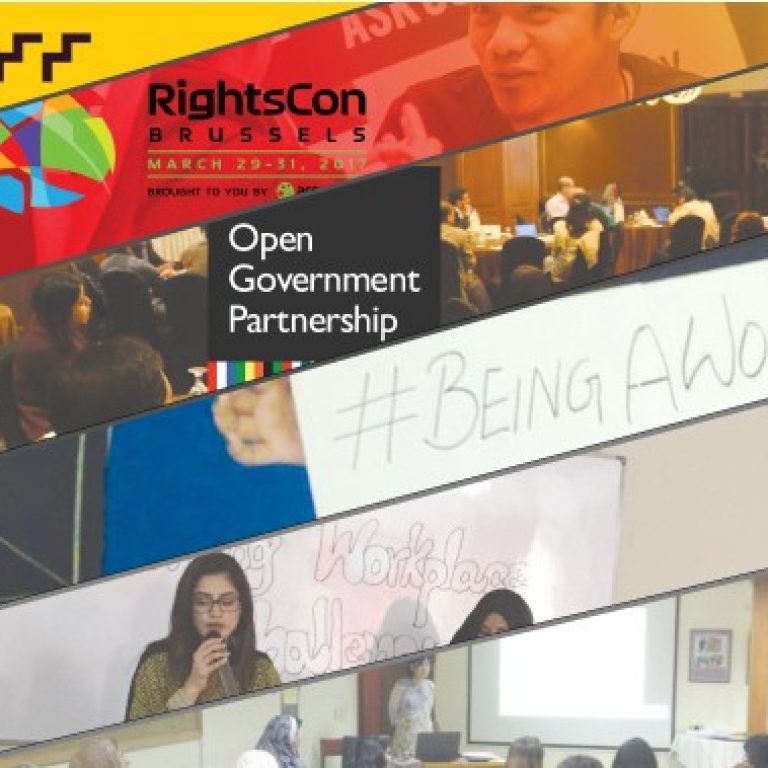
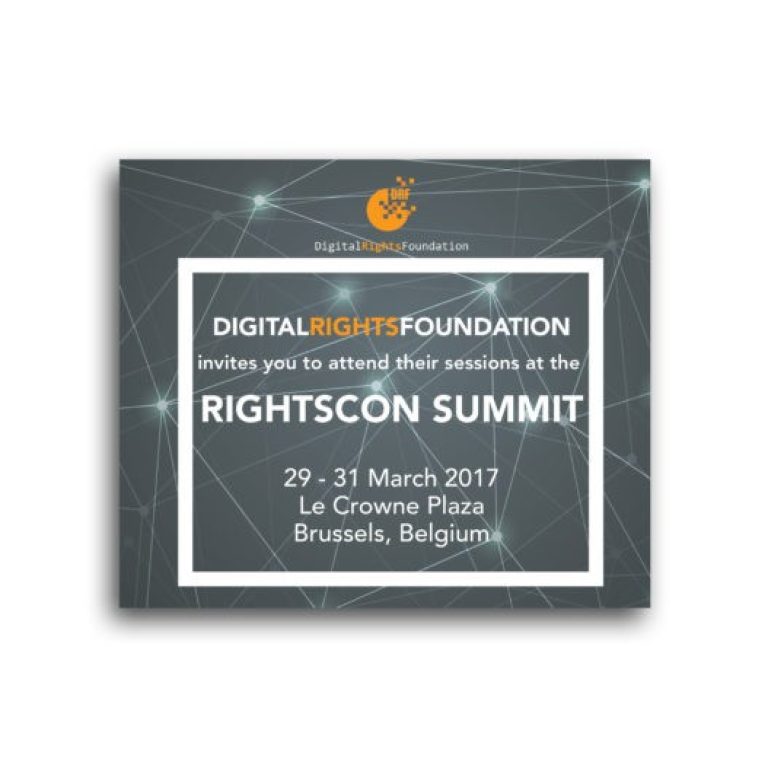
Digital Rights Foundation hosted four sessions at the RightsCon Summit 2017 held from March 29th to March 31st (and Day 0 on March 28th) in Brussels, Belgium. The conference is the world's leading event dedicated towards digital rights and brings together digital rights activists, journalists, policy makers, corporate personnel to discuss the future of the internet.

IMG_20170330_203616

DRF hosted panels ranging from topics such as “Surveillance and Privacy from the Margins”, online harassment with “Taking Matters into Our Hands: Addressing Online Harassment” and "Harassment Goes Deadly: the Global North vs Global South", and the future of the open internet with “Net Neutrality and its Future in the Developing World".

Here's a detailed post on what all was said and done at RightsCon.

International Contributions by DRF

This month was also a productive one in terms of DRF’s international contributions. Digital Rights Foundation has made submissions to the UNSG report on the Safety of Journalists, United Nations High Commissioner for Human Rights report on ways to bridge Digital Gender Divide (DGD) from a human rights perspective and the Universal Periodic Review for Pakistan 2017 on the topic of “Gender rights in Pakistan: Online violence, free speech and access to information”. We look forward to having these submissions make their mark in the subsequent reports.

Here are the dedicated blog posts on each submission:
UPR Submission | Submission to OHCHR to Bridge DGD |
Submission to UNSG on the Safety of Journalists

Open Government Partnership Workshop: Lahore

OGP Logo

The Open Government Partnership (OGP) Consultation was held in Lahore on March 15, 2017. The event was hosted by Open Society Foundations, Digital Rights Foundation, Punjab Information Commission and Punjab Lok Sujag. The event was a multi-stakeholder initiative that brought together members of civil society, the business community and government together on issues of open government, transparency and accountability.

The discussion revolved around the themes of fiscal transparency, access to information, citizen engagement/public service delivery, use of digital, access to justice, strengthening accountability (government integrity/anti-corruption/asset disclosure) and improving business environment. The discussion urged the government towards more proactive disclosure of information, effective accountability mechanisms and more transparent budgeting.

OGP Photo
Speakers at the event were Nighat Dad (Executive Director, Digital Rights Foundation), Shreya Basu (Regional Civil Society Coordinator for Asia Pacific, Open Government Partnership) and Natalia Tariq (Program Officer, Open Society Foundation, Pakistan).

Women's Day, 2017

Hyra

International Women’s Day is celebrated throughout the world on March 8th. This year, on account of this day DRF started a social media campaign with the hashtag #BeingAWomanMeans. Women from across Pakistan participated in the campaign and held out charts expressing what it meant for them to be a woman. Team DRF visited Emporium Mall Lahore to ask women to participate in the campaign and start a conversation on the many and diverse aspects that they believe means to be a woman. The campaign also gained traction online and created quite the buzz.

Session on Online Harassment at NED University

Hija 2

On March 16, Hija Kamran represented Digital Rights Foundation at a seminar on Online Harassment conducted by NED University's Humanities department in Karachi. During the session, Hija talked to the students about online violence and many effects of the experience on the survivor/victim, including social, psychological, and emotional impact. She also talked about the Cyber Harassment Helpline that DRF launched in 2016; the need for the collective efforts towards countering online harassment, what are the mechanisms of reporting cyber harassment to LEAs, the laws around cybercrimes in Pakistan, and other importing factors to deal with the said harassment.

Seminar on Online Violence at Shirkat Gah, Lahore

On March 22nd, Shirkat Gah - Women’s Resource Center hosted a seminar on Online Violence and Engendering Digital Equality by International Human Rights Lawyer Ms Zarizana Abdul Aziz. DRF was the respondent at the event. Zarizana discussed the aspect of violence against women in detail and talked about the implications of the online world in the offline life. She covered topics like freedom of expression of women, consent and privacy.  The audience was very interactive and there were a lot of discussions regarding different privacy and consent related issues the members had personally faced.

Shirkat Gah

Fatima A. Athar and Jannat Fazal represented DRF and talked about the stigma surrounding women’s privacy issues, and discussed how and why it is so difficult for women to make their voices heard when it comes to violence against them.  They talked about the DRF helpline and various practices that need to be adopted in routine life to safeguard from violence against women in online and offline spaces and privacy concerns.

 Islamabad High Court case to block blasphemous content online

the-social-media-ban-1489467611-1804

The Islamabad High Court has taken up a case regarding anti-Islamic material in online spaces by directing the Interior Minister, Ministry of Information Technology and Federal Investigation Authorities to take measures against such speech. The IHC ordered the Interior Ministry that if need be the entire social media should be blocked and strong action must be taken against anyone who is committing these crimes. The bench stated that due to these blasphemous posts being present online there are likely to be more cases like Mumtaz Qadri in which vigilantes take laws into their own hands. This has sparked a larger legal debate regarding social media websites and the responsibilities of these companies. As an extension of this, the government has threatened to block all social media websites if they don’t respond. Facebook has agreed to send a team to Pakistan to consult with the government--raising concerns regarding online speech.

The FIA has become quite active as well, it currently running television ads regarding the limits of free speech and three people have been arrested under charges of blasphemous content on the internet.

PEMRA Bans

bad-tv-screen-iii-rolling-footage-025195258_prevstill

Censorship of electronic media was also a highlight this month. PEMRA has also been quite active around censorship of content on electronic media. DAWN TV’s program “Zara Hut Kay” was taken off air for three days for comments against a sitting judge at the IHC. The morning show GEO Pakistan has been suspended for five days for broadcasting “indecent content”. Furthermore, HUM TV was fined been fined Rs. 1 million for airing the episode by the title of “Chew Gum” for its drama series “Kitni Girhein Baqi Hein”.

April 3, 2017 - Comments Off on Digital Rights Foundation at Internet Freedom Festival, 2017

Digital Rights Foundation at Internet Freedom Festival, 2017

Digital Rights Foundation participated in and was a partner at the Internet Freedom Festival (2017) held from March 6th to March 10th in Valencia, Spain. The primary agenda of the meeting was “joining forces to fight censorship and surveillance”. The event was a brought together digital rights activists, software developers, digital security trainers, communication professionals, journalists and designers from around the world bringing together their varied experiences and perspectives. The main themes for the event were community, training & best practices, internet freedom: present and future, tools & technology, regions & groups, communications & design and journalism & media.

Panels hosted by Digital Rights Foundation:

Surveillance from the Margins: Different Experiences of Surveillance

The panel discussed the different ways in which surveillance and surveilling agents discriminate on the basis of identity. The discussion revolved around the ways in which surveillance is experienced differently on the basis of gender, race, class, sexuality, ability and political/ideological views.

Moderator:
Nighat Dad (DRF)

Panel:
Bill Markzak (Citizen Lab)
Thenmozhi Soundararajan (Equality Lab)
Cheekay Cinco (Digital security trainer)
Stephanie Lacambra (EFF)

Taking Matters into Our Hands: Addressing Online Harassment

The panel discussed the different tools and strategies developed in different contexts to address online harassment. The discussion was action and policy-oriented, looking to discuss solutions. DRF talked about the successful launch of its Cyber Harassment Helpline and shared its work around tackling online harassment with an international audience.

Moderator:
Nighat Dad “(DRF)

Panel:
Shauna Dillavou
Lindsay Beck (OTF)
Meerim Ilyas (UAF)
Meg Hood

Data protection law and its different manifestations

The panel discussed the different kinds of data protection laws all over the world. The discussion was pivoted towards potential legislation in countries where there is a dearth of laws or inadequate legislation.

Moderator:
Nica Dumlao (EngageMedia)

Panel:
Mohamad Najem (Smex)
Nighat Dad (DRF)
Wafa bin Hussain (AccessNow)
Sarath M S  (SFLC)


March 25, 2017 - Comments Off on We’re Coming to RightsCon2017 and It’s Going To Be Big!

We’re Coming to RightsCon2017 and It’s Going To Be Big!

Every year, Access Now brings together digital rights activists from around the world in the world's leading event for the future of the internet - RightsCon Summit. And Digital Rights Foundation is thrilled to announce that just like the past few years, we'll be hosting a series of sessions at the conference this year and they'll be the reflection of what the team of DRF has been busy with in 2016.

First, here's a little background. The past year, we’ve been busy analysing the data protection and privacy situation in Pakistan and advocating for data protection laws and safe access to the internet. We concluded our year-long project “Hamara Internet” (Urdu for “Our Internet”) that trained over 2000 women from around the country on digital security and tools to counter cyber harassment, which ultimately led to the launch of Pakistan’s first Cyber Harassment Helpline in December 2016. We also launched two research studies -Telecoms Privacy and Data Protection Policies in Pakistan, and Surveillance of Female Journalists in Pakistan, along with a lot of other activities that had our attention throughout.

RightsCon Invite Website

Digital Rights Foundation’s sessions at RightsCon will be the reflection of all these activities, along with the discussion on some new challenges that are necessary to be addressed at the earliest. With this being said, here are the sessions that we’re hosting at the conference and hope for your participation if you're in Belgium, and support if you're in other parts of the world:

TAKING MATTERS INTO OUR HANDS: ADDRESSING ONLINE HARASSMENT THROUGH [TOOLS]

When: March 29, 2017 - 4 PM to 5 PM
Where: Clarity, 8th Floor - Le Crowne Plaza, Brussels, Belgium

This panel will discuss the different tools and strategies developed in different contexts to address online harassment. The discussion will be action and policy-oriented, looking to discuss solutions. The panel will have speakers from different geographic locations and organisations who will talk about the situation of cyber harassment in their respective regions and also the tools that they’ve applied (or intend to apply) to counter the said harassment.

The speakers line-up for this panel so far is:

Moderator:
Nighat Dad - Digital Rights Foundation, Pakistan

Speakers:

  • Elsa Saade - Gulf Center for Human Rights, Lebanon
  • Wafa Ben Hassine - Access Now

NET NEUTRALITY AND ITS SCOPE IN DEVELOPING WORLD

When: March 30, 2017 - 10:30 AM to 11:45 AM
Where: Harmony, First Floor - Le Crowne Plaza, Brussels, Belgium

This panel aims at discussing the highly-debated principles of Net Neutrality and Zero Rating and their situation in the developing world, in contrast with that in the developed countries. The session intends to address the problems and discuss the best laws and practices around Net Neutrality and how it affects the open and fair access to the internet, user experiences of the internet, user data privacy and protection protocols, and also the future of the internet in reference to Net Neutrality and paid-prioritisation of content online.

The confirmed speakers for this panel so far are:

Moderator: Raman Jit Singh Chima - Access Now

Speakers:

  • Hija Kamran - Digital Rights Foundation, Pakistan
  • Apar Gupta and Kiran Jonnalagadda - Internet Freedom Festival, India
  • Agustin Reyna - BEUC, Belgium
  • Gbenga Sesan - Paradigm Initiative Nigeria, Nigeria

SURVEILLANCE AND PRIVACY FROM THE MARGINS

When: March 30, 2017 - 5:15 PM to 6:15 PM
Where: Klimt, Ground Floor - Le Crowne Plaza, Brussels, Belgium

The panel hopes to discuss the different kinds of surveillance and the gendered nature of surveillance all over the world. The conversation will also be focused on how data protection and privacy laws need to be strengthened and how a breach of privacy can have dire consequences for individuals.

The confirmed speakers for this session so far are:

Moderator: Nighat Dad - Digital Rights Foundation, Pakistan

Speakers:

  • David Kaye - UNSR Freedom of Expression
  • Chinmayi Arun - National Law University, India
  • Carolina Botero - Karisma Foundation, Colombia
  • Courtney Radsch - Committee to Protect Journalists (CPJ)

HARASSMENT GOES DEADLY: THE GLOBAL NORTH VS GLOBAL SOUTH

When: March 31, 2017 - 4 PM to 5 PM
Where: Innovation, First Floor - Le Crowne Plaza, Brussels, Belgium

This panel aims at discussing online violence that is usually seen as a problem for the so-called “backward societies” around the world. The narrative goes that women and vulnerable communities in the third world are particularly susceptible to honour and gender-based crimes. High profile cases of online harassment leading to violence in offline spaces is seen as a reflection of an entire culture in the Global South, whereas it is couched in less cultural and societal terms in the North. The fact of the matter is that online violence against women is a global and universal problem.

There needs to be an open and honest debate of this culture-based critique mounted at the global south. Speakers from both side of the divide will come together on this panel to discuss the similarities and overlap between online violence around the world.

The confirmed speakers for this panel so far are:

Moderator: Hija Kamran - Digital Rights Foundation, Pakistan

Speakers:

  • Nanjira Sambuli - World Wide Web Foundation, Kenya
  • Bishakha Datta - Point of View, India
  • Japleen Pasricha - Feminism in India, India
  • Hera Hussain - Chayn Labs

After the consultation with the experts at these sessions and with your valuable participation, we hope to take the conversations forward and move towards taking necessary steps to preserve digital rights and making the internet safe and accessible for everyone.

See you at RightsCon!

Written by Hija Kamran

March 6, 2017 - Comments Off on Fake News, Obscenity, and Cyber Harassment: February ’17

Fake News, Obscenity, and Cyber Harassment: February ’17

February 2017 wasn't an easy ride for digital rights here in Pakistan. As we still await one of the five missing bloggers to return home, the law enforcement has been busy taking away citizens' rights to speak online under the draconian laws, poor journalism ethics ruled the TV screens and caused chaos in the country, and Digital Rights Foundation's Cyber Harassment Helpline completed its 3 months of operation. Here's a round up of the incidents that had out attention!

Samar Abbas: Still Missing

While it came to light at the end of January that 4 of the missing activists had returned home, Samar Abbas still missing remains missing. Samar’s disappearance has been linked to the series of enforced disappearances of activists and bloggers at the start of January--Samar was reported missing 11th January, 2017. Given the lack of information by the state authorities and the returned activists themselves, there is no clarity on why the activists were picked up or the reason Samar in particular remains missing.

Samar’s wife, Najamus Sahar, has spoken about the emotional toll the disappearance has taken on her family.

IMG-20170112-WA0030 (1)

In a petition directed at the missing bloggers, Justice Shaukat Aziz Siddiqui, through a single bench at the Islamabad High Court, ordered the Pakistan Telecommunications Authority to block pages or websites containing blasphemous material on social media. It is unclear how this order will be interpreted by the PTA. Furthermore, if the PTA chooses to follow the order what criteria is being used to determine content as blasphemous? While the PTA is at it, it would be great it they can also remove material containing hate speech against minorities and marginalised communities.

The Trend of Fake News and its Aftermath

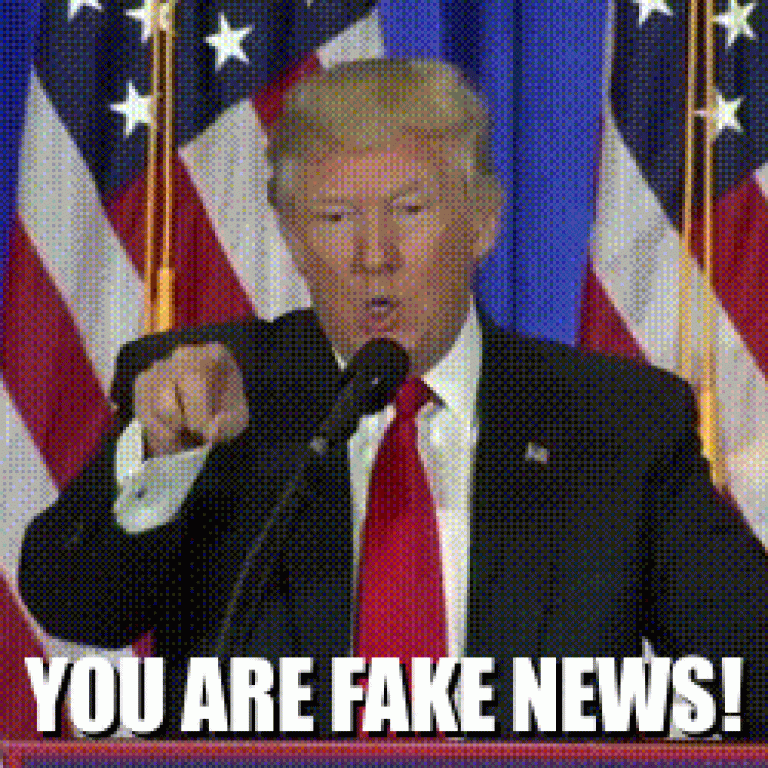
The term “fake news” has been weaponised by the current US president to target any news outlet that dares to fact-check him, however it has also become a referential point of analysis for pervasive news items and rumours that are demonstratively wrong, yet are still shared on social media and even picked up by the mainstream media. In times of mass confusion and lack of trust in official statements, fake news can become an agent of panic and paranoia. In the aftermath of the Lahore Defence bomb blast/cylinder explosion (there is still no clarity on which of these is fake news), panic gripped the streets of Lahore as social media, mainstream news channels and WhatsApp groups were inundated by the news of a bomb blast in Gulberg. 31 news channels were initially served a notice by PEMRA in the wake of this incident, out of which 29 news channels are fined and asked to air an apology on March 6th, 2017 between 6:00 PM and 7:00 PM in the same magnitude as the fake news was aired.

PEMRA Apology notice

For more clarity on fake news and how to counter it, read Hija Kamran’s post “F is for Fake News!” for DRF here.

Arrest of Nasir Khan Jan and "Obscenity" as a tool for Censorship

Social media celebrity Nasir Khan Jan is known for his videos and covers. However on 8th February, 2017 was arrested and detained by the Police on grounds of “obscenity”. While he was granted bail by a lower court in Lower Dir on 11th February, 2017, his case has been referred to the Cyber Crime Wing of the Federal Investigation Agency (FIA).

nasir

The police has informed the media that he was arrested under Section 107 of the Pakistan Penal Code, which deals with “instigation” of others. It is unclear what exactly the police are accusing Nasir Khan Jan of doing. This is a clear violation of his right to freedom of expression in online spaces and a case in which the vague terminology of obscenity is being used to intimidate online personalities.

Read DRF’s statement condemning the arrest here.

Cyber Harassment Helpline completes in third month!

DRF’s Cyber Harassment Helpline has marks 3 months of successful operations. Launched on 1st December, 2017, the Helpline has handled over 358 complaints in the short span of its operations. The Helpline Team hopes to expand and improve its services and outreach. Several innovative approaches towards outreach have already been taken.

The detailed report on the Cyber Harassment Helpline's first 3 months will be launched in coming days.

Facebook-cover

February 20, 2017 - Comments Off on F is for Fake News!

F is for Fake News!

During the US Presidential elections, it was claimed that fake news on Facebook may have contributed to Donald Trump’s victory over Hillary Clinton. Even though the claim was denied and called ‘crazy’ by Facebook CEO Mark Zuckerberg, there’s a great chance that it is correct to some extent, if not entirely. According to a survey conducted in 26 countries including US and UK, 51% people who have access to the internet use social media as their primary source of information and particularly news - Facebook being the most prominent source. With the Comet Ping Pong pizzeria incident where a man open fired at the restaurant to what he said ‘self-investigation’ for pedophilia claims against the owner of the pizzeria, it’s pretty much evident that fake news does influence people and makes them act as they perceive it.

While it’s not the only case where supposed fake news goes viral, there have been quite a lot of hoax news and stories throughout the last two years that the word ‘post-truth’ (an adjective relating to circumstances in which objective facts are less influential in shaping public opinion than emotional appeals) made it to Oxford Dictionaries in 2016, even though the word was first used in 1992.

Pakistan has not been left out of the whole ‘fake news’ trend. Back in 2013, Mubashir Luqman - a national TV host - on his live TV show ‘Khara Sach’ alleged that Lahore Grammar School (LGS), a private and leading school in Punjab, was converting its students to other religions and had supposedly excluded the subject “Islamiat” from the curriculum. In response to these allegations on a national TV, the principal of the concerned branch of LGS was forced to release a statement on the school’s official Facebook page where she stated,

Our institution believes in inculcating values such as tolerance and empathy in all our students. ‘Comparative religion’ is essentially a ‘history of religion’. It is NOT merely comparing religions; we aim to educate about Islam, Christianity, Buddhism, Zoroastrianism, and Hinduism – and their fundamental teachings. Doing so, we believe, will enlighten our students about the importance of ‘peaceful coexistence.”

This was a glaring example of poor journalism without fact-checks or thorough investigation. Despite the school’s clarifications, the news went viral and several Facebook pages used it to attack progressive educational institutes. For instance, this Facebook page with over 100,000 followers, posted a now-deleted viral image that equated other religions with satanic beliefs.

Fake news has also resulted in diplomatic tensions escalating. In December 2016, the Defense Minister of Pakistan Khawaja Muhammad Asif threatened Israel of nuclear attack in reaction to the fake news he read on Twitter.

"Israeli def min threatens nuclear retaliation presuming pak role in Syria against Daesh.Israel forgets Pakistan is a Nuclear state too AH" — Khawaja M. Asif (@KhawajaMAsif) Dec. 23, 2016

Apparently, Asif was reacting to a fake story published by awdnews.com. The article which was uploaded on December 20th wrongly attributed the statements to the Former Defense Minister of Israel, Moshe Yaalon.

@KhawajaMAsif The statement attributed to fmr Def Min Yaalon re Pakistan was never said” — Ministry of Defense (@Israel_MOD) Dec. 24, 2016

@KhawajaMAsif reports referred to by the Pakistani Def Min are entirely false” — Ministry of Defense (@Israel_MOD) Dec. 24, 2016

Earlier in January 2017, five bloggers and activists went missing in Pakistan, in what is believed to be forced disappearances. While the reason of their kidnapping is still unknown, a smear campaign against the bloggers was launched by right wing groups, and their followers. One of the most influential scholars and live TV host Amir Liaquat Hussain joined into this irresponsible behaviour by accusing them of blasphemy. It’s important to note that in an Islamic state like Pakistan, blasphemy is a criminal offence and the punishment is either death or imprisonment for life.

Section 295 C of the Blasphemy Law states,

Whoever by words, either spoken or written, or by visible representation or by any imputation, innuendo, or insinuation, directly or indirectly, defiles the sacred name of the Holy Prophet Muhammad (peace be upon him) shall be punished with death, or imprisonment for life, and shall also be liable to fine.”

Once those prominent and powerful in media endorsed the allegations, the public was quick to jump on the bandwagon and there was a widespread belief that the missing bloggers had committed blasphemy. The vicious campaign forced the families, who were already going through the trauma of losing their loved ones, to deny the allegations. The families were of the view that the blasphemy allegations were meant to divert the attention from their disappearance.

These accusations weren’t limited to just bloggers but were extended to human rights defenders too. Amir Liaquat Hussain alleged Muhammad Jibran Nasir, who is a frontline human rights activist, of profanity. The allegations, again, were made on a live TV show where thousands of people were watching (subsequently shared online as well) who believed what Hussain, who happens to be the scholar, said. These false proclamations of serious nature not only endanger the accused but also the ones related to them. As a result, Nasir who was in the forefront demanding immediate recovery of the missing bloggers filed a complaint of defamation against Hussain to the Pakistan Electronic Media Regulatory Authority (PEMRA). The Authority, after the pressure of civil society and citizens who complainedc, banned Amir Liaquat Hussain’s show ‘Aisa Nahi Chalay Ga’ on BOL News.

On February 14, 2017, Hadiqa Kiani - an iconic singer of Pakistan - was accused of being arrested at the London Heathrow Airport for possessing cocaine worth 80,000 British Pounds. The singer immediately slammed the rumours by posting a photo with her son and mother on her twitter account,

“Photo taken TODAY in Lahore with my mother and son! Cannot believe how this FAKE London news has been spread” - Hadiqa Kiani (@Hadiqa_Kiani) - February 14, 2017

She also responded to one of the tweets directed to her to confirm the news with,

completely false. I dare anyone to associate drugs with my name. Don't believe me, contact U.K. authorities” - Hadiqa Kiani (@Hadiqa_Kiani) - February 14, 2017

Not only does misinformation spread via social media forums like Facebook and Twitter, but people also receive messages on WhatsApp and other messaging apps that can’t be verified by the average citizen, and hence there is a tendency to believe the said message. After the recent bomb blast in Lahore on February 13, 2017, security alerts started making rounds on WhatsApp claiming that the Inter-Services Public Relations (ISPR) - the media wing of Pakistan Army - has declared security high alert in the major cities of Pakistan.

Another ‘notification’ attributed to ISPR, circulated via WhatsApp, asks the receiver to not respond to any call or SMS from a number mentioning either #90 or #09 as it could take their cellular network SIM card in their control and use it for malicious activities like bomb blasts.

Fake News 1

Now the worrying part here is that once attributed to the defense forces, people tend to believe the message and goes viral without any fact-checking and without verifying the source of information. Law Enforcing Agencies (LEAs) don’t disseminate sensitive and classified information in public and the security threats are usually dealt with on an official level. The news can be ‘leaked’ but the security breaches in the systems and communications of military forces aren’t very common. Here, it’s also important for the people to take informed decision to trust or ignore the news by pondering over a few simple questions, 1) Is the source reliable? 2)  Have you heard of this source before? 3) Can this news be verified by a more reliable source, say a reputed media outlet or journalist? 4) Is it humanly and technically possible for the classified information to make its way in the mainstream media and in public? 5) Are there any tags like ‘Satire’ or ‘Parody’ associated with the news?

Abraham

According to a research study, fake news spreads more drastically than the stories that debunk them. Social media plays an important part in making or breaking the reputation of any person or organisation, and the consequences could sometimes be life-threatening. Poor journalism and spreading of rumours play a pivotal role in what is believed to be character assassination on the basis of personal biases.

Paid reviews and contributions by supposedly reputed media outlets or individuals add to the culture of fake news. A lot of times, these said individuals and outlets endorse a service or a product, or just a story in return of monetary advantages. These reviews are not harmful if the reader is informed about its sponsored nature but often times people tend to uncritically follow the advice of the endorser. This practice is very common particularly in tech industry and the beauty industry where a blogger posts reviews which are not necessarily honest.

As a nation and due to our enshrined differences, we tend to believe anything that’s been said under quotation marks and in bold attributed to a famous or historical person. Often times, it has been seen that anything attributed to a reputed organisation is taken as an absolute truth when in fact the reality could be otherwise. This doesn’t only affect a normal person or a group of people, but also harms the reputation of the organisation in question.

The websites or outlets that share fake news live off the revenue generated by the ads on their webpages. The most ridiculous or outrageous the story, the more it attracts people to the website, either to get more details and post even more outrageous comments under the fake news, or to satisfy their curiosity and bash the source later. Again, Facebook’s algorithm is the most crucial tool to promote the news by classifying it ‘most popular’. The more people click, share, comment, or react to the post, the more it’s shared with people and goes viral. Hence, more money for the owner of the content.

It’s essential that as agents of disseminating news, journalists, media outlets, and other individuals and organisations who are believed to be opinion-changers and influencers invest in responsible journalism and research what they share with the listeners and readers. Strong fact-checking mechanisms need to be developed before something becomes mainstream and goes viral.

Furthermore, it’s also important to engage with the government and non-governmental bodies, working on the well-being of the society and its people, to request - and if necessary, force - them to be more transparent in their actions. This is important for two reasons, a) because this way dissemination of fake news will be harder, and b) people will be able to fact-check themselves once the mechanisms are developed and advocated.

Remember: Everything you see or read isn’t true. There’s a chance it’s edited to satisfy someone’s personal biases. Always fact-check what you see. Additionally, here’s a list of pointers by wikipedia to identify good source and bad source on the internet. Interestingly, 10 points for Wikipedia to honestly classify itself as bad source.

Here’s how an informed decision can be taken to either believe or reject the news/claim, courtesy of Emergent.info - a real time rumour tracker.

Author: Hija Kamran

February 20, 2017 - Comments Off on Social Media & “Obscenity” in Pakistan

Social Media & “Obscenity” in Pakistan

Nasir Khan Jan is a social media celebrity and v-logger who rose to fame because of his off-key covers of songs and awkward photo shoots. However on 8th February, 2017 he was arrested by the KPK Police on charges of “obscenity”.

His home was raided, and he was humiliated in front of his family and neighbours. He was subjected to the fear and distress of finding himself suddenly labelled a criminal, and grappling with the threat of judicial proceedings. It was not until his bail was posted by the admin of another Facebook page that the ordeal ended, at least for the time being. Meanwhile, another nightmare awaited him as he returned home only to find someone had photographed him while he was handcuffed in police custody and the pictures had gone viral, leading to another barrage of derogatory and mocking attacks, adding to the psychological burden of this trauma. Nasir was further told by both the detaining authorities and commenters on social media that if he wishes to avoid a repeat of the same incident, he should stop making videos in which he does “immoral” activities such as “dancing” and singing.

But who decided what constitutes obscene and immoral? The Prevention of Electronic Crimes Act (PECA)  gives authorities broad powers to remove content that is against “decency or morality” (refer to section 37 of the Act)  but what is the objective, legally-applicable definition of such subjective terms? It is unclear exactly which section was used to arrest Khan Jan, however section 294 of the Pakistan Penal Code could possibly have been used. Section 294 states that:

Obscene acts and songs: Whoever, to the annoyance of others, -- (a) does any obscene act in any public place, or (b) sings, recites or utters any obscene songs, ballad or words, in or near any public place, shall be punished with imprisonment of either description for a term which may extend to three months, or with fine, or with both.”

How do we decide the limits of morality and immorality? Whose narratives of the same are imposed through the criminalisation of activities such as singing, dancing, and personal v-logging? Why are these types of content prompt punitive action while pages promoting hate speech, sectarianism, violence against women and various minorities, or increasing religious extremism are tolerated?

DRF is unequivocally against the actions taken by these law enforcement authorities supposedly at the behest of an as-yet unknown complainant and stands in support of Nasir Khan Jan as well as all digital citizens engaged in the creating content that empowers the growth of New Media. We see these actions as a clearcut part of an ongoing and disturbing pattern of criminalising, harassing, and silencing individual voices online.

Our stance is fourfold:

  • Nasir Khan Jan's arrest and subsequent events are a grievous act of cyberbullying crossing the boundary between “digital” and “physical” by permitting harassers to have their victim arrested, publicly humiliated online as well as offline, and threatened with court proceedings for posting videos that they personally found “immoral”. This sets a dangerous precedent for the extent and seriousness of cyberbullying and must not be allowed to slip by without resistance. All citizens are entitled to the same protections from the state; moral policing negates this right by making the state a stakeholder in upholding certain moral codes above others.

  • The contrast between Nasir Jan’s arrest and the impunity of pages belonging to banned terrorist outfits and violent sectarian groups highlights that this is a struggle for the right to public space that is ever shrinking and that must not ceded further.
  • The fact that Nasir’s privacy was further compromised and his leaked pictures continued to force him to relive this event even though he was granted bail, and even though his “alleged crime” was in the nebulous and legally ill-defined territory of “obscenity”, and despite the fact that in the eyes of the law we are all deemed innocent until proven guilty. This infers that the government of Pakistan is not adequately equipped to handle arrested suspects’ right to privacy while in police custody. It also points towards a lack of sufficient oversight on part of the state to ensure the responsible implementation of its own laws. This casts a shadow over its commitment to uphold the digital safety and rights of its citizens, ostensibly one of the primary reasons why the PECA was passed.
  • The members of the law enforcement authority that supposedly received this complaint also decided Nasir Khan Jan was guilty, and enacted punishment accordingly. This is a gross violation of human rights as well as digital rights. It cannot and must not be tolerated at any cost.

Nasir Khan Jan ’s arrest represents a violent escalation of threats to citizens’ post-PECA’ digital rights in an increasingly interconnected world. It raises deep issues of the breaking divide between “online” and “offline” and shows us clearly how non-normative personalities, presentations, and people are disproportionately at risk from not only online vigilantes but also organs of the state.

February 8, 2017 - Comments Off on Internet Freedom, Public Threats, and the Year Ahead

Internet Freedom, Public Threats, and the Year Ahead

January 2017 was one eventful month at Digital Rights Foundation. From protests for and return of the missing activists to hate speech by an acclaimed TV host on live television, from the launch of anti-harassment mobile application by Punjab Government to blocking of a satire website - DRF team has been busy at work throughout. And here's a round-up of all the activities that had our attention:

Missing Activists:

The month of January started out with the troublesome news that five activists had gone missing from Pakistan. Salman Haider (Islamabad), Ahmed Raza Naseer (Nankana), Ahmed Waqas Goraya (Lahore), Aasim Saeed (Lahore) and Samar Abbas (Karachi) all disappeared in the first month of the new year. The reason for their disappearance is still unclear but it is likely that they were targeted on the basis of their online speech. Civil society activists conducted protests all across Pakistan in the wake of these disappearances, and international pressure was also mounted on the government. Digital Rights Foundation also took part in the protest in Lahore.

IMG-20170112-WA0030 (1)By the end of January, reports surfaced that the missing activists had made contact with their families. There are several unanswered questions regarding the disappearances and many of the returned are reluctant to speak out about their ordeal. One of the activists had left the country following his release.

Another worrying aspect of these disappearances were the concerted social media campaigns to malign these missing activists, one that was backed up by the mainstream media and presenters, such as Amir Liaquat.

Amir Liaquat, Free Speech and PEMRA

Amir Liaquat is the host of the program “Aisa Nahi Chalay Ga” on Bol TV. In the month of January, has been accusing several activists and journalists of anti-Pakistani activities as well as levelling blasphemy charges against progressive voices.

After thousands of complaints from citizens, PEMRA (the regulatory agency for electronic media), issued an order banned Amir Liaquat’s appearance any TV channel:

PEMRA's Order to BOL TV

PEMRA's Order to BOL TV

Bol TV however did not immediately comply with PEMRA’s order and continued to air Amir Liaquat’s show despite the hate speech and incendiary content of his speeches.

The Supreme Court of Pakistan has come down hard on Bol and the channel signed an undertaking pledging not to air Amir Liaquat’s show until further notice by the court.

Khabristan Times Blocked in Pakistan

KT

Pakistan’s satire publication, Khabaristan Times (KT) has been blocked in Pakistan since January 25.

Digital Rights Foundation strongly condemned the ban in its official statement and stands in solidarity with the publication.


Statement by KT

Statement by KT

Initiatives by the Punjab Government

16684669_1189689211129997_672714307_nThe Punjab government launched its Women Safety Smart Phone Application. The app was launched on January 4, 2017 by the Punjab Safe Cities Authority (PSCA) in collaboration with the Punjab Commission on Status of Women. This application allows allows users to send notifications to the Police Integrated Command, Control and Communication (PPIC3) if there is an incident of harassment and security forces will be dispatched to the location immediately. The application also allows users to mark places and locations as “unsafe”, which will help authorities in planning activities and other users as well.

Digital Rights Foundation attended the launch event for the application. We shall follow up with the developers and the authorities regarding our problems with permissions and privacy policies of the application. The fact that the application gains access to a lot of personal data as displayed in the permissions section, the onus is on the authorities to assure citizens about why the data is collected and how it is securely stored.
WhatsApp Image 2017-02-08 at 13.03.23 (1)WhatsApp Image 2017-02-08 at 13.03.23

The Punjab government also launched around 192 hotspots in three big cities of the province, including Lahore, Rawalpindi and Multan. According to reports, in order to log in citizens will be required to given their name, date of birth, profession and mobile number. Digital Rights Foundation is also concerned about the information that this required for this service and the monitoring of online activity with users are logged into the service.

Internet Shutdown persists in FATA

Digital Rights Foundation was recently alerted to the fact that internet services in Federally Administered Tribal Areas (FATA) have been suspended since June 12, 2016. This denial of internet access to a large segment of Pakistan’s population has gone unexplained by the authorities, and DRF will continue to highlight the issue until services are adequately restored.
You can read our blog post on the issue here.

Safer Internet Day

DRF organized a workshop on account of international Safer Internet Day on the 7th of February in Beaconhouse School System Boys Branch. Seerat Khan, Jannat Fazal and Huda Jilani conducted the workshop with the enthusiastic secondary school students, which was based on cyberbullying and the safety measures children should adopt while using the internet. During the workshop, children also designed posters and wrote about how they felt about cyberbullying. The need of these workshops in schools was recognized and a survey was also conducted to understand the nature of cyberbullying in schools. DRF hopes to expand the project to more schools in the near future.
16652656_1189740877791497_949201035_nunnamed

English Works opening ceremony in Karachi

16142511_10154272452578870_7361294837987059840_nOn January 18, 2017, Hija Kamran - Communications Manager at Digital Rights Foundation, spoke to the students at English Works opening ceremony - a six month English learning course - organised by Evolution in partnership with the U.S. Consulate General Karachi. During her talk, Hija emphasized on the importance and need of Women Rights in Digital Spaces, Cyber Harassment, and how to counter the said harassment. Along with this, Hija also discussed the harassment that Qandeel Baloch faced, and the harassment that 22 year old Naila Rind faces for three months which ultimately led her to commit suicide in her hostel room.
16142277_10154272453013870_778718956603286206_n

Seminar by Search for Justice - CAN Pakistan

Huda Jilani, Program Assistant at Digital Rights Foundation, was a speaker and panelist at a seminar conducted by Search for Justice (an initiative by CAN Pakistan) and the Social Work Department at Lahore College University for Women on January 18, 2017. The seminar focused on Online Harassment specifically in context of social media and ways and strategies to avoid it. Mr. Shahid Hassan, a representative of the FIA, was also a speaker at the event.
16106029_807579819382582_6315217771010722071_n
16105647_807579816049249_5987354570554086616_n

Harassment as a Legal Concept in Cyber Law

Shmyla Khan, the Project Head of Cyber Harassment Helpline at Digital Rights Foundation writes,
"Harassment, unfortunately, is a fact of life for many women in spaces other than the place of work. Most public spaces are hostile environments for women. It is for this reason that street harassment is also criminalised under section 509 the PPC in Pakistan. It comes as no surprise that cyber spaces are no different when it comes to the experience of women and minorities. Out of the 3027 cybercrime cases reported to the FIA during August 2014- August 2015, 45% involved electronic violence against women (e-VAW)."

Read the full article "Harassment as a Legal Concept in Cyber Law" here.


February 2, 2017 - Comments Off on Surveillance of Female Journalists in Pakistan

Surveillance of Female Journalists in Pakistan

cover

This is a pilot study that explores the gendered surveillance that female journalists experience.

The study details the experiences of seven female journalists and the surveillance that they face in the course of their work and beyond. The research focuses on the gendered forms and the different sources of surveillance, including the state, audience members and political groups. The female journalists interviewed for the study stated that not only were they surveilled by state authorities, but are also subjected to constant social surveillance in the form of abuse on social media - largely directed at their gender and appearance, rather than their work. In addition to mapping the forms of surveillance faced by female journalists, the report also explores the impact that this constant monitoring has, in terms of the psychological toll, self-censorship and retreat from digital spaces.

Surveillance of Female Journalists in Pakistan