
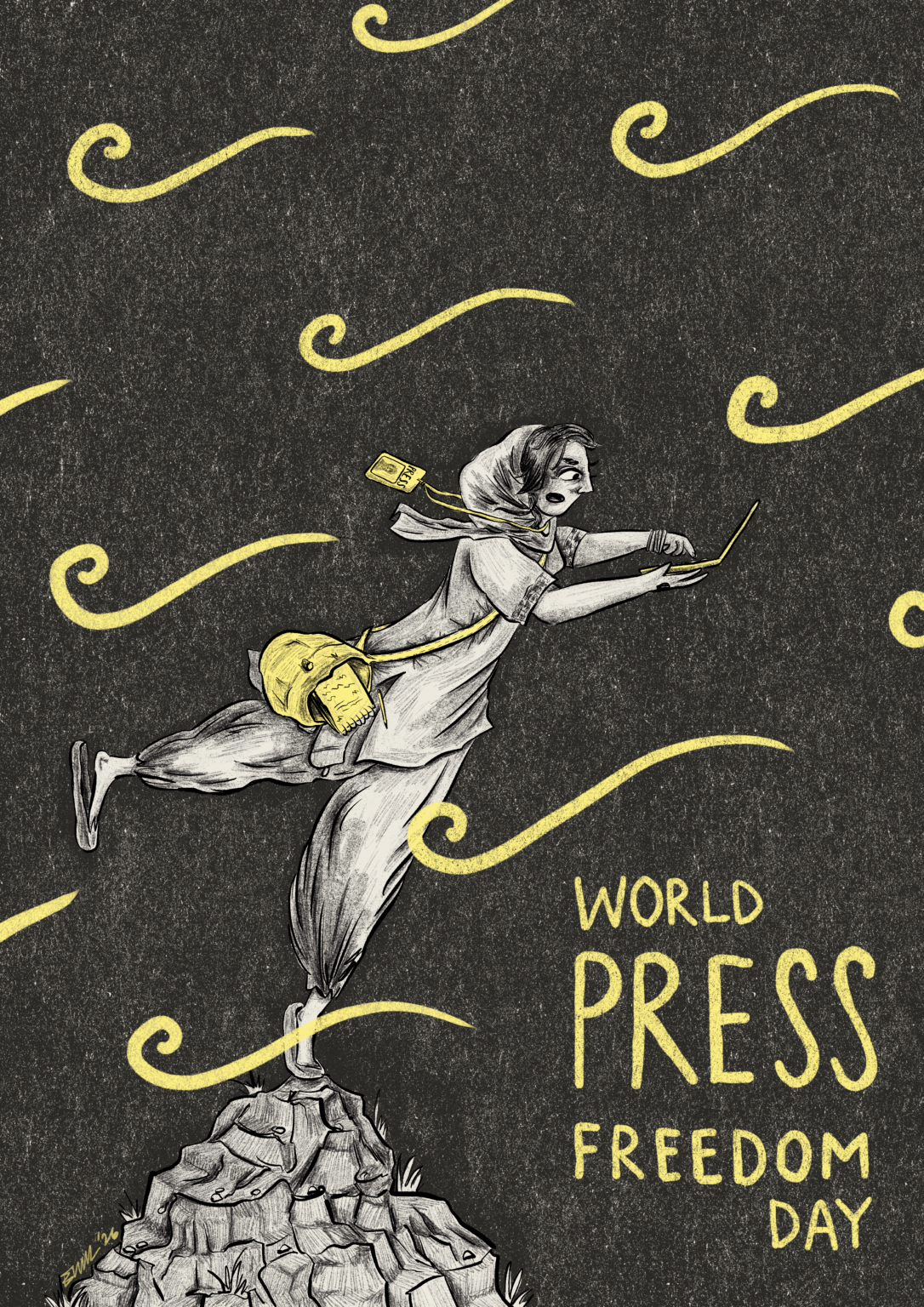
Digital 50.50’s third edition, “Voices from the Margins: Reclaiming Press Freedom in Rural and Underserved Communities,” our special World Press Freedom Day edition, is finally here. While delayed, the conversations in this issue could not be more timely.
This edition comes at a moment when press freedom in Pakistan continues to face unprecedented challenges. According to the Reporters Without Borders (RSF) World Press Freedom Index, Pakistan ranks 153rd out of 180 countries, showing the increasingly difficult environment in which journalists work in the country. It arrives at a time when journalist Mian Zahid Owais was violently attacked for reporting on drug trafficking, when unidentified assailants opened fire at the residence of journalist Ihsan Khattak after months of threats and when journalist Sohrab Barkat was arrested following his reporting on protests in Azad Kashmir. At the same time, the continued expansion and use of the Prevention of Electronic Crimes Act (PECA) has further intensified legal pressure on journalists, while human rights defenders and activists continue to face arrests, intimidation and shrinking civic space.
Yet beyond these headline making incidents lies another reality that often escapes national attention. Across Pakistan, particularly in rural and underserved communities, journalists work at the intersection of limited resources, political pressure, digital exclusion, inadequate infrastructure, and significant safety risks. Their reporting is essential to documenting local realities, holding power to account and ensuring that communities beyond urban centers are represented in public discourse. Despite these challenges, many rural and local journalists continue to report on issues that receive little or no attention from mainstream media. Their coverage of the arrests and incarceration of activists such as Imaan Mazari, Hadi Chattha, Mahrang Baloch, and Sibghat Ullah Shah Jee demonstrates both the importance and resilience of local journalism. Even with limited institutional support and heightened personal risk, these journalists continue to document human rights violations, amplify marginalized voices and ensure that critical information reaches the public. As media ecosystems evolve, emerging technologies, platform-driven news consumption, internet shutdowns, and widening digital divides further shape who gets to tell stories and whose stories are ultimately heard.
This edition centers those voices. Through stories, reflections, and analysis from women and gender-diverse journalists, writers and storytellers, we explore what press freedom looks like beyond Pakistan’s major cities. We examine the challenges of reporting from remote and conflict-affected regions, the impact of digital exclusion on journalism, the role of local media in preserving community narratives and the resilience of those who continue to report despite immense personal and professional risks.
As editors, this edition is especially meaningful because it reminds us that press freedom cannot be measured solely by the ability of national media to operate freely. It must also be measured by whether journalists in villages, small towns, border regions and marginalized communities have the resources, safety, dignity and freedom to tell their own stories. Protecting press freedom means protecting every journalis not just those in our largest newsrooms.
We hope this edition serves as both a tribute to the courage of journalists working on the frontlines and a call to strengthen protections for those whose reporting is too often overlooked.
With love,
Seerat Khan
Co-editors: Sara Imran, Maria Nazar and Ahsan Zahid
Illustrator: Emil Hasnain